
Three Days to Go: Understanding Your Landlord's Quickest Eviction Threat

What a 3 Day Notice Really Means for Landlords and Tenants
A 3 day notice is a formal written demand from a landlord requiring a tenant to either pay overdue rent or vacate the property — and it is the first legal step toward eviction in most U.S. states.
Here's what you need to know at a glance:
| Question | Quick Answer |
|---|---|
| What is it? | A written demand to pay rent owed or move out within 3 days |
| Who uses it? | Landlords in most U.S. states, including California, Florida, Iowa, and New Mexico |
| When does the clock start? | The day after the notice is served |
| Do weekends count? | No — most states count business days only, excluding weekends and holidays |
| What happens if ignored? | The landlord can file an eviction lawsuit (unlawful detainer) |
| Can it be challenged? | Yes — defects in content or service can make it legally void |
It sounds simple. Three days, pay or leave. But the rules around how the notice must be written, served, and timed are surprisingly easy to get wrong — and a single mistake can get the whole case thrown out of court.
For a small landlord managing a duplex or triplex, that means lost time, lost rent, and a costly restart from scratch.
I'm Isaac Spragg, founder of LionsGate Property Management, and handling 3 day notices correctly is something I've navigated as both an investor and a full-service property manager across Providence, Cranston, Warwick, and the wider Rhode Island market. In this guide, I'll walk you through exactly how these notices work, what makes them valid, and how to protect yourself — whether you're the one serving the notice or receiving it.
What is a 3 Day Notice and How Does It Work?
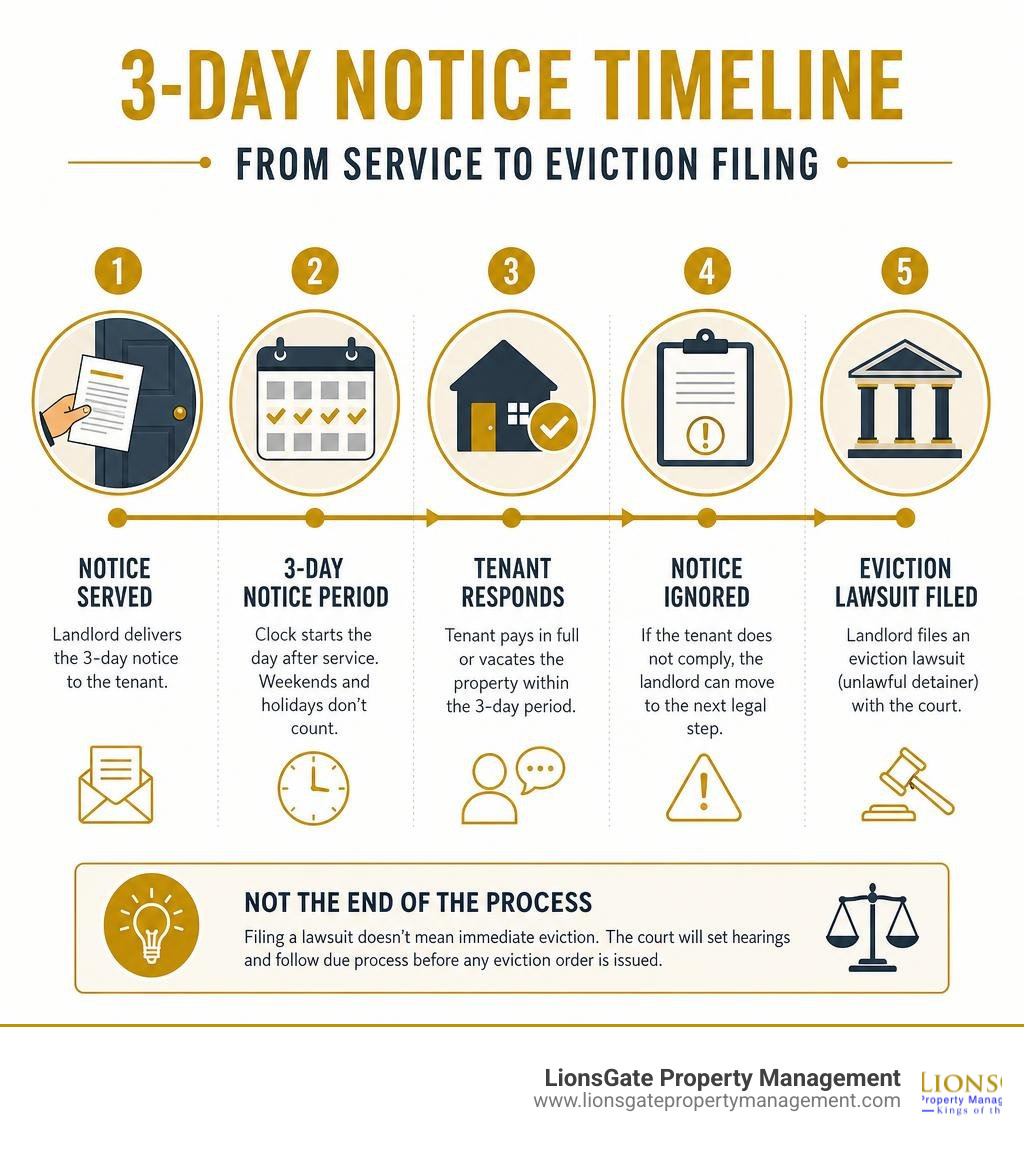
At its core, a 3 day notice is a legal warning shot. It is not an eviction order. A landlord cannot legally change your locks, throw your belongings on the sidewalk, or shut off your utilities when this notice expires. Instead, it is a mandatory preliminary step. Under state laws, a landlord must provide written notice and a chance for the tenant to resolve the issue before they can file an eviction lawsuit (often called an "unlawful detainer" action) in court.
The most common version of this document is the "3-Day Notice to Pay Rent or Quit." In plain English, "quit" means to vacate the property. The notice gives the tenant a simple binary choice: pay the exact amount of back rent owed within three days, or pack up and move out. If the tenant does neither, the landlord gains the legal right to take the matter to court.
While the "pay or quit" variety is the most common, landlords also use 3-day notices for other lease violations. For example, a "3-Day Notice to Perform Covenants or Quit" is used when a tenant violates a non-monetary lease term—such as keeping an unauthorized pet or parking in the wrong spot. In these cases, the tenant has three days to correct the violation (perform the covenant) or leave. Finally, there is an unconditional "3-Day Notice to Quit," which gives the tenant no option to fix the problem. This is typically reserved for severe issues, such as illegal drug activity on the property or causing significant, malicious damage.
Understanding how this works is critical for anyone renting or managing property. If you want a deeper look at how the entire process unfolds from start to finish, you can read more in this 3-Day Notice to Pay Rent or Quit in California: Tenant Guide.
State-by-State Variations in Notice Periods
While the 3-day timeline is incredibly common across the United States, landlord-tenant laws are strictly state-specific. What works in Florida or California will not fly in Rhode Island or Minnesota.
- Florida: Under Florida Statute 83.56, if a tenant fails to pay rent, the landlord must deliver a written 3-day notice. If the tenant doesn't pay or vacate within those three days (excluding weekends and legal holidays), the landlord can immediately terminate the rental agreement and file for eviction.
- Iowa: Iowa landlords must also provide a 3-day notice of nonpayment before filing an eviction. However, Iowa law has a unique twist: if a landlord decides to mail the notice instead of hand-delivering it, the law assumes it takes 4 days for mail delivery. This automatically extends the tenant's payment window to 7 days.
- Minnesota: Minnesota takes a completely different approach. A 3-day notice to quit is strictly reserved for substantial lease violations, illegal activity, or severe property damage. If the issue is simply unpaid rent, Minnesota law requires a 14-day notice with a right to cure before a landlord can take legal action.
- Rhode Island: For our local property owners in Providence, Cranston, Warwick, Pawtucket, and North Providence, the rules are entirely different. Rhode Island does not use a 3-day notice for nonpayment. Instead, under Rhode Island law, rent must be at least 15 days late before a landlord can send a formal 5-day demand notice. If the tenant does not pay within those five days, the landlord can then file a nonpayment eviction in the District Court.
Navigating these differences is tough, especially if you own properties in multiple states or are trying to apply national advice to a local Rhode Island multi-family home. To see how these timelines fit into the broader legal landscape, check out our guide on How to Navigate the Tenant Eviction Process.
Anatomy of a Legally Binding Demand
Because an eviction notice is the foundation of a lawsuit, judges inspect them with a magnifying glass. If the notice contains even a minor technical error, a tenant's attorney can easily get the eviction case dismissed. If that happens, the landlord must start the entire process over—costing hundreds of dollars in court fees and weeks of lost rental income.
Here is a quick look at what separates a legally bulletproof notice from one that will get thrown out of court:
| Feature | Valid Notice | Invalid Notice |
|---|---|---|
| Demanded Amount | Only past-due rent, calculated to the exact penny. | Rent plus late fees, utility charges, or hypothetical future rent. |
| Cure Period | Clearly calculated business days, excluding weekends and holidays. | Calendar days that ignore weekends or local judicial holidays. |
| Payment Details | Names the person to pay, their address, and available hours. | Simply states "pay me" without clear instructions or location. |
| Statutory Disclosures | Includes state-required language regarding legal consequences. | Lacks mandatory legal warnings or state-specific disclosures. |
Essential Elements of a Valid 3 Day Notice
To ensure your notice stands up in court, it must include several key pieces of information.
First, it must clearly state the full, legal names of all adult tenants living in the unit, along with the complete and accurate address of the rental property (including apartment or unit numbers).
Second, it must state the exact amount of past-due rent. You cannot guess or round up. Furthermore, you cannot include late fees, interest, utility bills, or bounced check charges in this demand—even if your lease agreement says those fees are considered "additional rent." The notice must demand only actual unpaid rent.
Third, the notice must include explicit payment instructions. It must state the name, address, and telephone number of the person to whom the rent should be paid. If the tenant is expected to pay in person, the notice must specify the days of the week and the hours during which payment can be made.
Finally, the notice must contain clear, state-compliant warnings. For example, in California, recent court rulings—specifically the landmark Eshagian v. Cepeda decision—require landlords to explicitly state the exact start date of the notice, the end date, which holidays are excluded, and the precise legal consequences of failing to comply. If you need a compliant template to see what this looks like in practice, you can download a Free California 3-Day Notice to Pay Rent or Quit | PDF.
Calculating the Timeline and Serving the Notice
Calculating the three-day window is one of the most common places where landlords trip up. You cannot simply count three days on your calendar and file a lawsuit on the fourth day.
The golden rule of notice timelines is this: the day of service does not count. If you hand-deliver a 3 day notice to a tenant on a Tuesday, Wednesday is Day 1, Thursday is Day 2, and Friday is Day 3. The tenant has until the very end of the business day on Friday to pay.
Additionally, you must exclude Saturdays, Sundays, and legal judicial holidays. If you serve a notice on a Thursday, Friday is Day 1. Saturday and Sunday are skipped entirely. Monday becomes Day 2, and Tuesday is Day 3.
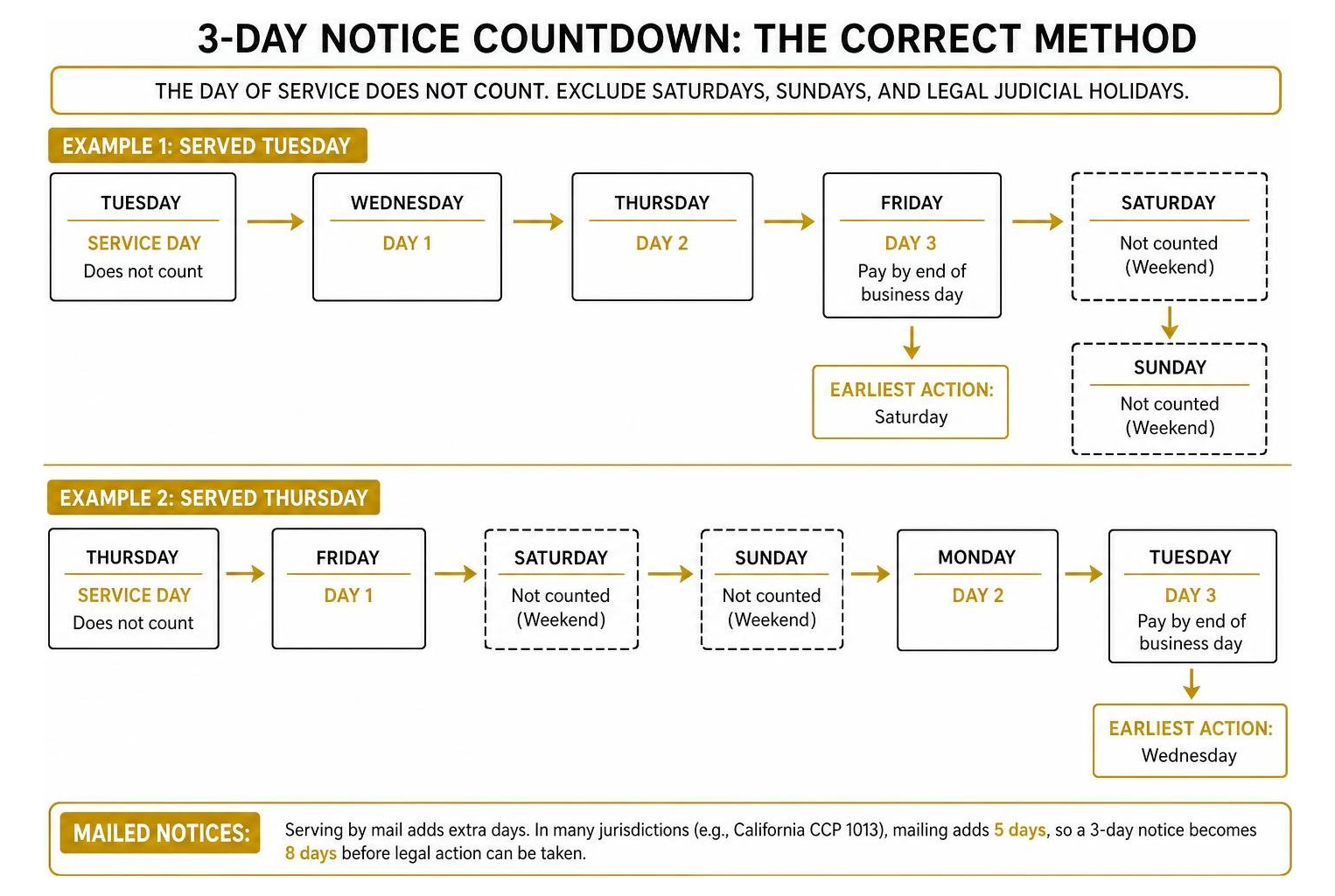
Things get even more complicated if you serve the notice by mail. In many jurisdictions, mailing the notice automatically adds extra days to the timeline to account for postal transit. For example, under California’s CCP 1013, serving a notice by mail adds an automatic 5 days to the notice period. That means a 3-day notice served by mail effectively becomes an 8-day notice before you can take any legal action.
Legal Service Methods and Proof of Service
You cannot simply slip a 3 day notice under a tenant's door or send it via a text message. State laws strictly dictate how these notices must be delivered. If you do not use an approved method, the court will rule that the tenant was never properly served.
Generally, there are three legal methods for serving a notice:
- Personal Service: Handing a copy of the notice directly to the tenant. This is always the best and most legally secure method because it leaves no room for the tenant to claim they didn't receive it.
- Substituted Service: If the tenant is not home, you can leave a copy with a person of "suitable age and discretion" (usually a co-tenant or adult family member) at the property, and then mail a second copy to the tenant's address.
- Post and Mail (Nail and Mail): If no one is home and you cannot find a suitable person to accept the notice, you can attach (post) a copy of the notice to the front door of the property, and then mail a second copy via certified or registered mail.
No matter which method you use, you must complete a formal Proof of Service (or Declaration of Service) form. This document must be signed by the person who delivered the notice, detailing the exact date, time, and method of delivery. If you end up in court, this Proof of Service is the primary evidence you will use to prove you followed the law.
Tenant Rights, Defenses, and Resolving the Notice
Receiving a 3 day notice is incredibly stressful, but it is important for tenants to remember that they have rights throughout this process. The most important of these is the right to cure. If a tenant pays the full amount of rent demanded within the three-day window, the landlord must accept the payment, and the eviction process is legally over. The landlord cannot refuse the money in order to force the tenant out.

If a tenant attempts to pay the rent in full and the landlord refuses to accept it, the tenant should carefully document the attempt. Take photos of the cashier's check or money order, send a follow-up email or text confirming the refusal, and keep a paper trail. This documentation can act as a complete defense in court.
However, if a tenant has legitimate reasons for withholding rent—such as severe maintenance issues—the situation changes. Under the legal doctrine of habitability, tenants have the right to live in a safe, clean, and functional home. If a landlord refuses to fix major issues like a broken heating system in the middle of winter, a lack of running water, or a severe mold infestation, the tenant may have a legal defense for withholding rent. To understand the limits of this defense and how "constructive eviction" works, read our detailed breakdown of The Uninhabitable Truth About Constructive Eviction in Real Estate.
Common Mistakes That Can Void a 3 Day Notice
Landlords frequently make mistakes when drafting and serving notices, and savvy tenants (or their attorneys) can use these errors to defeat an eviction case. Some of the most common mistakes include:
- Including Late Fees: As mentioned earlier, demanding late fees, utility charges, or court costs on a 3-day notice to pay rent or quit will immediately void the notice in almost every court.
- Vague Violation Descriptions: If you are serving a notice for a lease violation (like an unauthorized pet), you cannot simply write "lease violation." You must provide specific details, dates, and times so the tenant knows exactly what they need to fix.
- Retaliation: Landlords cannot serve an eviction notice in retaliation for a tenant exercising their legal rights—such as reporting a building code violation to the city of Providence or joining a tenant union.
- Ignoring Just-Cause Eviction Laws: Many areas have strict "just-cause" eviction protections (such as AB 1482 in California or local rent control ordinances). Under these laws, landlords cannot simply end a tenancy without a legally recognized reason, and notices must contain specific statutory disclosures to be valid.
What Happens After the Notice Expires?
If the three-day window closes and the tenant has neither paid the rent nor moved out, the landlord's next step is to file an eviction lawsuit. In the legal world, this is called an unlawful detainer.
Once the lawsuit is filed, the tenant must be formally served with a summons and complaint. The tenant then has a set number of days to file a written response with the court. If the tenant fails to respond, the landlord can win a default judgment. If the tenant does respond, a court hearing will be scheduled, during which both sides can present their evidence to a judge.
It is important to understand that evicting a tenant is a slow, highly regulated, and expensive process. Between court filing fees, process servers, and attorney fees, the costs add up quickly. If you want to know what to expect financially, you can read our breakdown on How Much Does It Cost to Evict a Tenant.
Frequently Asked Questions about Eviction Notices
Can a landlord include late fees in a 3-day notice?
No. A 3 day notice to pay rent or quit must only demand actual, unpaid past-due rent. Including late fees, interest, utility bills, or other non-rent charges will make the notice legally defective, and a judge will likely dismiss your eviction case.
How are weekends and holidays counted in the 3-day period?
In almost all states, weekends (Saturdays and Sundays) and official judicial holidays are excluded from the three-day countdown. The clock starts the day after the notice is served, counting only business days.
What should I do if I receive an incorrect notice?
If you receive a notice with the wrong rent amount, missing information, or incorrect dates, you should document the errors immediately. You can point out the mistakes to your landlord in writing, or consult with a local legal aid organization or tenant attorney to prepare your defense in case the landlord attempts to file an eviction.
Conclusion
Managing rental properties is a rewarding investment, but navigating the legal minefields of evictions, notices, and tenant disputes can quickly turn a dream investment into a stressful nightmare. Whether you are dealing with a tenant who stopped paying rent in Cranston or trying to draft a legally compliant notice in Warwick, a single administrative slip-up can cost you thousands of dollars and months of wasted time.
At LionsGate Property Management, we believe rental property ownership should be completely stress-free. We offer full-service rental property management for duplexes, triplexes, and small-to-mid-size apartment buildings across Rhode Island, including Providence, Cranston, Warwick, Pawtucket, and North Providence.
To protect our owners, we offer a robust suite of guarantees, including guaranteed rent, proactive maintenance, professional snow removal, and no-cost evictions. If a tenant we place needs to be evicted, we handle the entire legal process and cover the costs ourselves—saving you the headache and protecting your bottom line.
If you are currently dealing with a difficult tenant situation or simply want to protect your portfolio from future rental losses, check out our guide on What to Do if Tenants Don't Pay Rent and Won't Leave, or reach out to us today to see how we can help you manage your Rhode Island properties with confidence.