
The Uninhabitable Truth About Constructive Eviction in Real Estate

What Constructive Eviction in Real Estate Actually Means (And Why It Matters)
Constructive eviction in real estate occurs when a landlord's actions — or failure to act — make a rental property so uninhabitable that a tenant is effectively forced to leave, even without a formal eviction notice.
Here's the quick answer:
Constructive Eviction: Fast Facts
| Question | Answer |
|---|---|
| What triggers it? | Landlord conduct or neglect that substantially interferes with a tenant's use and enjoyment |
| Does the tenant have to leave? | Yes — the tenant must vacate within a reasonable time |
| What's the legal basis? | Breach of the implied covenant of quiet enjoyment |
| What does the tenant gain? | Release from the lease and no further rent obligation |
| What must the tenant do first? | Give written notice and allow the landlord time to fix the problem |
Think of it this way: a landlord doesn't need to change your locks to effectively push you out. Ignoring a broken furnace all winter, letting a mold infestation spread unchecked, or cutting off utilities can all accomplish the same thing — and courts treat it the same way.
This is not a minor technicality. A successful constructive eviction claim can void a lease entirely, eliminate a tenant's rent obligation, and expose a landlord to significant financial liability.
For small landlords managing duplexes or triplexes in Providence and surrounding Rhode Island communities, understanding this doctrine is essential — both to protect your tenants and your investment.
I'm Isaac Spragg, founder of LionsGate Property Management, and I've seen how preventable maintenance issues can escalate into costly constructive eviction in real estate disputes for local property owners. In this guide, I'll walk you through everything you need to know — from the legal elements courts require to the practical steps that keep landlords protected.
Understanding Constructive Eviction in Real Estate vs. Actual Eviction
To understand how constructive eviction works, it helps to contrast it with actual eviction. In an actual eviction, the landlord physically or legally removes the tenant from the property. This is typically done through formal court proceedings (such as a summary process) or, unlawfully, through "self-help" measures like changing the locks or removing the tenant's belongings.
By contrast, constructive eviction involves no physical lockouts or legal eviction notices. Instead, the landlord allows the conditions of the property to deteriorate so severely — or engages in conduct so intrusive — that the tenant has no choice but to abandon the premises. The law treats this severe neglect as equivalent to a physical eviction because the tenant has been deprived of the "beneficial use" of the home they are paying for.
Under US common law, the doctrine of constructive eviction acts as a critical shield for tenants. According to the legal experts at Cornell Law School's constructive eviction | Wex | US Law | LII / Legal Information Institute, a successful claim completely absolves the tenant of their duty to pay future rent and serves as an absolute defense if the landlord sues for back rent.
| Feature | Actual Eviction | Constructive Eviction |
|---|---|---|
| Initiated By | Landlord | Tenant (as a response to landlord neglect/actions) |
| Physical Action | Tenant is physically excluded or ordered to leave by a court | Tenant chooses to pack up and vacate due to unlivable conditions |
| Legal Status | Formal court process required (unless an illegal lockout occurs) | A legal defense or claim raised after the tenant has vacated |
| Rent Obligation | Terminated by court order or physical lockout | Suspended once the tenant abandons the property |
The Legal Elements of Constructive Eviction in Real Estate
Winning a constructive eviction case is not as simple as pointing to a leaky faucet or a drafty window. Because the remedy is so powerful — completely breaking a contract — courts hold these claims to a high standard. To successfully prove constructive eviction in real estate in most U.S. jurisdictions, a tenant must satisfy four distinct legal elements:
- Landlord Act or Omission: The landlord must have committed an intentional act or omission that directly led to the poor conditions. "Intent" does not require a malicious plot to drive the tenant out; legal intent can be inferred if the landlord simply knew about a severe issue and chose to do nothing.
- Substantial Interference: The issue must be severe enough to permanently deprive the tenant of the use and enjoyment of the property. Minor inconveniences do not qualify.
- Notice and Opportunity to Cure: The tenant must have notified the landlord of the defect in writing and allowed a reasonable timeframe for repairs.
- Actual Abandonment: The tenant must actually pack up and move out. You cannot claim constructive eviction if you are still living in the unit.
As highlighted in legal analyses of Quiet Enjoyment and Constructive Eviction | Law.com, courts view constructive eviction as an extraordinary remedy because it completely suspends the tenant's lease obligations. Consequently, there is no simple "bright-line" test; judges evaluate claims on a case-by-case basis, looking at the cumulative impact of the landlord's behavior.
The Implied Warranty of Habitability and Quiet Enjoyment
At the heart of every lease agreement are two fundamental legal doctrines: the implied covenant of quiet enjoyment and the implied warranty of habitability.
The covenant of quiet enjoyment is an old common-law rule that guarantees the tenant the right to peaceably possess and use the property without disturbance from the landlord or third parties under the landlord's control. A violation of this covenant is the primary legal engine behind a constructive eviction claim.
Meanwhile, the implied warranty of habitability is a modern statutory protection. Established in the landmark 1970 case Javins v. First National Realty Corp., this doctrine mandates that landlords must keep residential properties safe, clean, and fit for human habitation.
As detailed in Constructive Eviction & Uninhabitable Conditions: The Complete Tenant Guide (2026) | ReadYourLease, the warranty of habitability is non-waivable. This means even if a landlord writes a clause into a lease stating "tenant accepts the property as-is and waives all repair rights," courts will throw that clause out as void and against public policy.
Common Grounds and Examples of Constructive Eviction

What does constructive eviction look like in the real world? While every case is unique, certain landlord behaviors and property failures are routinely recognized by courts as valid grounds for a claim.
According to Constructive Eviction Examples: What Qualifies and What Doesn’t - LegalClarity, common triggers include:
- Loss of Essential Utilities: Failing to provide heat during freezing winter months, leaving a property without running water, or intentionally shutting off electricity to force a tenant out.
- Severe Health and Safety Hazards: Ignoring toxic black mold growth, failing to remediate lead paint or asbestos exposure, or allowing severe, unchecked rodent and insect infestations to take over the home.
- Structural Defects: A collapsing ceiling, a severely leaking roof that floods rooms during rainstorms, or broken exterior doors and window locks that leave the property completely insecure.
- Deliberate Landlord Interference: Repeated, unannounced entries by the landlord at odd hours to harass or intimidate the tenant, or physically removing essential appliances (like the stove or refrigerator) without replacing them.
A classic case example is Johnson v. Cabrera, where a frozen pipe prevented the use of a rented building during the winter. Because the landlord failed to address the issue, the court ruled that the tenant was constructively evicted and freed from rent liability.
Severe Health Hazards vs. Temporary Inconveniences
It is crucial to distinguish between a genuine habitability crisis and a temporary inconvenience. Courts will not support a constructive eviction claim for minor annoyances.
For example, a broken air conditioner during a mild week, a single clogged drain, or daytime construction noise from a neighboring lot for a few weeks will not justify breaking a lease. To meet the legal threshold, the condition must be so severe that it threatens the tenant's health and safety or completely prevents them from using the space for its intended purpose. However, courts do consider the cumulative effects of multiple minor issues. A dozen unresolved moderate code violations can collectively cross the threshold into constructive eviction.
Can a Tenant Claim Partial Constructive Eviction?
Yes, in some jurisdictions, a tenant can claim partial constructive eviction. This occurs when a landlord's actions or neglect make a specific, distinct portion of the property entirely unusable, forcing the tenant to abandon that section while remaining in the rest of the unit.
Under the Constructive Eviction in New York rule, for instance, a tenant may be entitled to a proportional rent abatement if they are deprived of the beneficial use of specific rooms (such as a bedroom made unusable by a collapsing ceiling), even if they do not vacate the entire apartment. This concept is also highly relevant in commercial leases, where a business might lose access to its warehouse or parking garage while keeping its main storefront open.
The Tenant's Procedural Roadmap and Risks
Claiming constructive eviction is a high-stakes legal move. If a tenant makes a mistake in the process, they could find themselves sued for thousands of dollars in unpaid rent, facing a ruined credit score, and carrying a negative tenant screening record.
To protect themselves, tenants must follow a strict procedural roadmap. Understanding this process is also vital for landlords, as it highlights the exact steps they must take to resolve issues before a tenant legally walks away. For a deeper look at the broader eviction landscape, check out our guide on How to Navigate the Tenant Eviction Process.
Notice Requirements and the Reasonable Time to Vacate
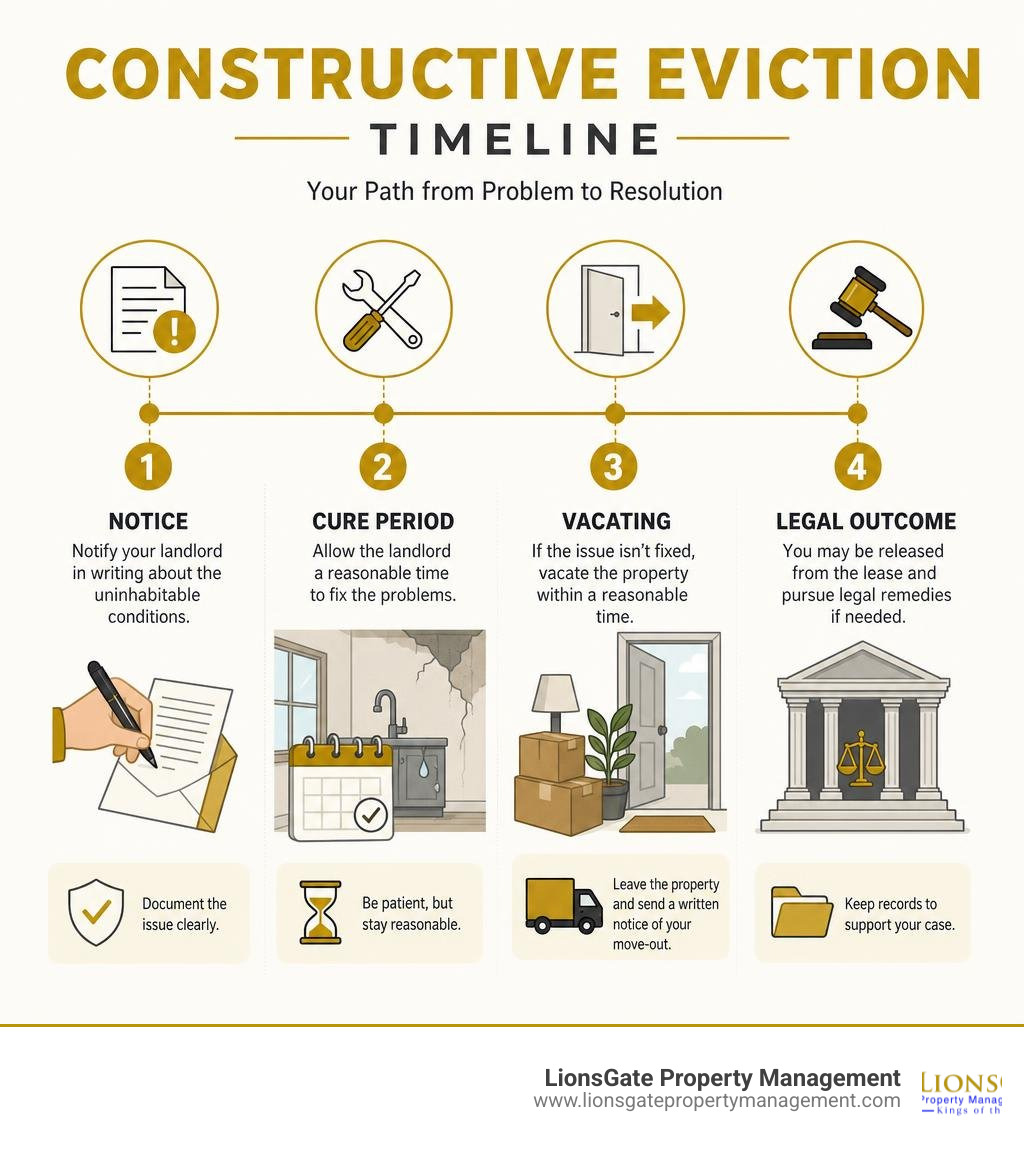
A tenant cannot simply wake up to a broken pipe, pack their bags, and claim constructive eviction that afternoon. The law requires that the landlord be given notice and an opportunity to cure the defect.
- Written Notice: The tenant must notify the landlord of the specific issue in writing. Sending this via certified mail with a return receipt is the gold standard, as it provides undeniable proof of delivery.
- Reasonable Cure Period: The landlord must be given a reasonable amount of time to fix the problem. What is "reasonable" depends on the severity. An emergency like a heating failure in January requires action within 24 to 48 hours. A non-emergency issue, like a leaky window, might allow for 7 to 14 days.
- Reasonable Time to Vacate: If the landlord fails to cure the issue within a reasonable timeframe, the tenant must vacate. If the tenant stays in the property too long after the landlord's failure to repair, courts will assume the conditions were not actually severe enough to force them out, defeating the claim.
- Note on Commercial Leases: In commercial settings, "reasonable time" is interpreted more broadly. Because relocating a medical practice or retail store is highly complex, courts have accepted delays of 12 to 18 months when supported by expert testimony explaining the relocation timeline.
Documentation Strategy: Building an Evidentiary File
Because the burden of proof rests on the tenant, maintaining a flawless paper trail is essential. A winning constructive eviction defense relies on hard evidence:
- Visual Evidence: Date-stamped photos and videos of the damaged areas, mold, pests, or utility meters.
- Written Communication: Copies of all emails, text messages, certified letters, and maintenance portal requests sent to the landlord.
- Daily Logs: A written timeline documenting when the issue started, when the landlord was notified, and how the issue impacted daily life.
- Third-Party Reports: Official inspection records from the local building department or board of health.
- Financial Records: Receipts for out-of-pocket expenses, such as space heaters, hotel stays, or professional cleaning services. All of these records should be immediately backed up to secure cloud storage.
Interaction with Rent Withholding and Repair-and-Deduct
Constructive eviction is an "exit-only" remedy — it requires leaving the property. However, tenants often attempt other self-help remedies first, which can complicate legal disputes.
- Rent Withholding: In many states, tenants can withhold rent if a landlord fails to make repairs, often placing the money into a court-supervised rent escrow account.
- Repair-and-Deduct: Some jurisdictions allow tenants to pay for repairs themselves and deduct the cost from their next rent check, though this is often capped (frequently at one month's rent).
If a tenant simply stops paying rent and refuses to leave, they are not claiming constructive eviction; they are withholding rent. If they do this incorrectly, the landlord may have grounds to file a nonpayment eviction. Landlords facing this situation can find guidance in our article on What to Do if Tenants Don’t Pay Rent and Won’t Leave.
Landlord Defenses and State-Specific Rules

Just as tenants have strict rules to follow, landlords have powerful defenses they can raise in court to fight a constructive eviction claim. If a tenant claims they were forced out, a landlord can defeat the claim by proving any of the following:
- No Written Notice: The tenant never officially notified the landlord of the problem, depriving them of the chance to fix it.
- Reasonable Repair Efforts: The landlord acted promptly, hired licensed professionals, and made diligent, reasonable efforts to cure the issue, but was delayed by factors outside their control (e.g., waiting on backordered parts).
- The Condition Wasn't Severe: The issue was a minor aesthetic defect or temporary inconvenience, not a major habitability failure.
- Tenant-Caused Damage: The severe condition was caused by the tenant's own negligence, abuse, or failure to maintain basic cleanliness (e.g., a pest infestation caused by hoarded trash).
- Failure to Vacate Timely: The tenant remained in the property for months after the issue arose, proving the unit was still livable.
Landlords must understand these defenses and keep immaculate maintenance logs, as defending against a lawsuit can be incredibly expensive. For more context on the costs involved in legal property disputes, read our guide on How Much Does It Cost to Evict a Tenant.
State-Specific Variations of Constructive Eviction in Real Estate
Landlord-tenant law is highly localized. While the general principles of constructive eviction in real estate apply nationwide, individual states modify these rules through specific statutes:
- Texas (Texas Property Code § 92.008): Texas has strict statutory penalties for landlords who attempt illegal self-help. If a landlord unlawfully cuts off utilities or removes doors/fixtures, they face statutory liability of one month's rent plus $1,000, actual damages, court costs, and reasonable attorney's fees.
- Wisconsin (Wis. Stat. 704.07(4)): Wisconsin law explicitly states that if a rental unit becomes "untenantable," the tenant may move out and is not liable for rent after vacating, provided the landlord does not promptly repair the defect.
- Florida (Section 83.60): Florida residential tenants must provide a strict statutory 7-day written notice to the landlord before they can legally withhold rent or terminate the lease due to habitability issues.
- Rhode Island: In our home state, the landlord-tenant relationship is governed by the Rhode Island Residential Landlord and Tenant Act (RI Gen. Laws § 34-18). Rhode Island courts strictly enforce the warranty of habitability. If a landlord fails to provide essential services like heat or hot water, local tenants have the right to secure alternative housing and recover damages. To learn more about local regulations, see A Primer on the Rhode Island Eviction Process.
For property owners in Providence, Cranston, Warwick, Pawtucket, and North Providence, staying compliant with local ordinances is essential. We have put together detailed local resources to help, including How to Handle Evictions in Providence and Beyond, Keep Your Keys with These Providence Eviction Assistance Programs, and The Landlord’s Guide to Low-Cost and No-Cost Eviction Programs.
Remedies and Damages Recoverable by Tenants
If a tenant successfully proves constructive eviction in court, they are entitled to significant remedies:
- Lease Termination: The tenant is immediately released from any further obligations under the lease.
- Security Deposit Refund: The landlord must return the security deposit in full, subject only to lawful deductions unrelated to the constructive eviction.
- Moving Costs: The tenant can recover the expenses incurred from being forced to pack up and relocate on short notice.
- Rent Differential: If the tenant is forced to rent a comparable apartment at a higher monthly rate, the landlord may be ordered to pay the difference for the remainder of the original lease term.
- Attorney's Fees and Court Costs: Many jurisdictions award reasonable legal fees to the prevailing party in habitability disputes.
Frequently Asked Questions about Constructive Eviction
Can a tenant claim constructive eviction while still living in the property?
No. Actual abandonment of the property is a strict legal requirement for a constructive eviction claim. If you are still living in the home, you cannot argue that the home is completely unlivable. However, if your state recognizes partial constructive eviction, you may be able to claim a rent reduction if you have completely abandoned a specific, unusable part of the unit.
What happens if a tenant's constructive eviction claim fails in court?
If the court rules against the tenant, the tenant will be treated as having abandoned the lease without legal justification. This means the tenant will be held liable for all remaining rent due under the lease, will likely forfeit their security deposit, and could face additional collections actions, legal fees, and damage to their credit history.
Are commercial tenants treated differently than residential tenants?
Yes. While the core elements of constructive eviction apply to both, commercial tenants face a higher burden. Residential tenants are protected by the non-waivable implied warranty of habitability. Commercial leases, however, rarely feature an implied warranty of habitability. Commercial tenants must rely strictly on the express terms of their lease and the common-law covenant of quiet enjoyment. Furthermore, because commercial relocations are complex, courts allow commercial tenants a much longer "reasonable time" to vacate the property.
Conclusion: Protect Your Property, Protect Your Income
At the end of the day, constructive eviction in real estate is entirely preventable. It is almost always the result of a breakdown in communication, deferred maintenance, or a landlord's slow response to critical property issues.
For property owners in Providence, Cranston, Warwick, Pawtucket, and North Providence, managing rentals shouldn't be a source of legal anxiety. At LionsGate Property Management, we help landlords deliver a stress-free ownership experience. We specialize in duplexes, triplexes, and small-to-mid-size apartment buildings across Rhode Island.
By offering proactive maintenance, guaranteed rent programs, dedicated snow removal, and no-cost evictions, we ensure your properties remain safe, compliant, and highly profitable.
Don't let a minor maintenance delay turn into a costly courtroom battle. Partner with Rhode Island's trusted property management team. If you are currently dealing with a tenant dispute or want to ensure your properties are fully protected, read our expert advice on What to Do if Tenants Don’t Pay Rent and Won’t Leave or contact us today to learn how we can safeguard your investments.