
How to Handle Evictions in Providence and Beyond

When You Need Rhode Island Eviction Services: What Landlords Should Know First
Rhode Island eviction services cover everything from serving the initial notice to coordinating the final removal with a constable — and if you're a landlord dealing with a problem tenant right now, here's the fast answer:
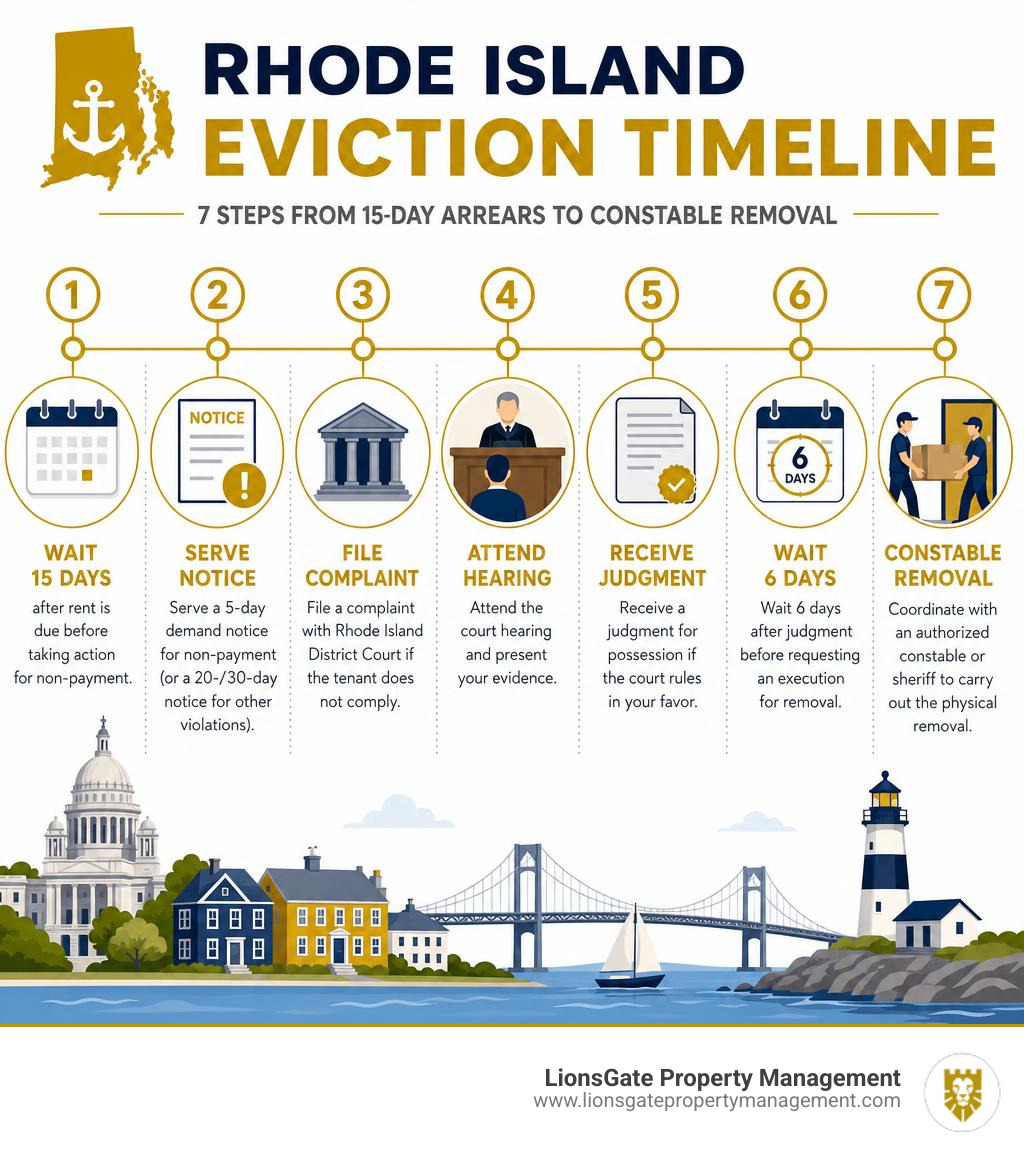
Quick overview of the Rhode Island eviction process:
- Wait 15 days after rent is due before taking action for non-payment
- Serve a 5-day demand notice for non-payment (or a 20-/30-day notice for other violations)
- File a complaint with Rhode Island District Court if the tenant does not comply
- Attend the court hearing and present your evidence
- Receive a judgment for possession if the court rules in your favor
- Wait 6 days after judgment before requesting an execution for removal
- Coordinate with an authorized constable or sheriff to carry out the physical removal
Rhode Island District Court has jurisdiction over all landlord/tenant matters with no dollar cap — unlike general civil cases, which are capped at $10,000.
Eviction in Rhode Island is a court-driven process. Landlords cannot remove a tenant on their own. Every step must follow the rules set out under Title 34, Chapter 18 of the Residential Landlord and Tenant Act — or you risk serious legal exposure.
That's easier said than done when you're managing a duplex in Providence and just want the situation resolved without losing months of rent.
I'm Isaac Spragg, founder of LionsGate Property Management, and I've dealt with the stress of evictions as a rental property owner in Rhode Island — which is exactly why I built a management system that handles Rhode Island eviction services as part of full-service property management. In the sections below, I'll walk you through every stage of the process so you know exactly what to expect.
Understanding the Rhode Island Eviction Process
The legal framework governing landlord-tenant relationships across Cranston, Warwick, and Providence is Title 34, Chapter 18 of the Rhode Island General Laws, officially known as the Rhode Island Residential Landlord and Tenant Act. This statute is incredibly strict, meaning even a minor procedural error—such as serving a notice a day too early or utilizing the wrong statutory form—can force a landlord to restart the entire legal process from scratch.
In Rhode Island, the District Court holds exclusive jurisdiction over all eviction actions. While standard civil matters filed in District Court are limited to a jurisdictional amount of $10,000, landlord-tenant evictions have no dollar limit. This means whether a tenant owes $1,500 or $50,000 in back rent, the case will still be heard in the local District Court.
Dealing with a tenant who refuses to cooperate can be incredibly stressful. If you find yourself in this situation, it is crucial to understand What to Do If Tenants Don't Pay Rent and Won't Leave to protect your investment. To avoid these issues entirely, many smart property owners turn to proactive solutions like The Landlord's Dream: Guaranteed Rent in Providence and Cranston, which keeps cash flow steady even during tenant transitions.
Residential vs. Commercial Rhode Island Eviction Services
Eviction procedures vary significantly depending on the property type:
- Residential Properties: Residential tenancies are heavily protected by state laws. Landlords must strictly adhere to statutory notice periods, use specific court forms, and respect tenant rights regarding property access, habitability, and security deposits. Self-help evictions (like changing locks) are strictly illegal.
- Commercial Properties: Commercial evictions are primarily governed by the terms of the commercial lease agreement and general state contract law rather than the Residential Landlord and Tenant Act. The court generally assumes that commercial tenants and landlords are business entities with equal bargaining power, allowing for faster proceedings and fewer statutory safety nets for the tenant.
Non-Payment of Rent vs. Lease Violations
The legal path you take depends entirely on why you are evicting the tenant:
- Non-Payment of Rent: This is the most common reason for eviction. Under Rhode Island law, you must wait until the tenant is at least 15 days in arrears before you can take any formal legal action. Once day 15 passes, you can officially serve the tenant with a 5-day demand notice.
- Lease Violations: If a tenant is violating non-monetary terms of the lease (such as keeping unauthorized pets, damaging the property, or causing noise disturbances), you do not have to wait 15 days. Instead, you must issue a 20-day notice of non-compliance, which grants the tenant a specific cure period to correct the issue.
Required Notices Under Rhode Island Law
Before you can file an eviction lawsuit in District Court, you must serve the tenant with the appropriate written notice. Failing to use the correct statutory language or failing to provide proof of service will result in the court dismissing your case.

| Notice Type | Required Waiting Period | Primary Purpose | Right to Cure? |
|---|---|---|---|
| 5-Day Demand Notice | 15 Days after rent is overdue | Eviction for non-payment of rent | Yes, tenant can pay within 5 days |
| 20-Day Notice | Immediate upon violation detection | Eviction for lease non-compliance | Yes, 20 days to cure (1st offense only) |
| 30-Day Notice | Prior to the start of the next rental period | Termination of tenancy-at-will / month-to-month | No, notice to vacate |
| 30-Day Subsidized Notice | Prior to filing court action | Termination of subsidized housing tenancy | Depends on program guidelines |
The 5-Day Demand Notice for Non-Payment
If rent is due on the first of the month, it is not legally "in arrears" for eviction purposes until the 16th of the month. On or after the 16th, you can serve the official 5-Day Demand for Non-Payment of Rent.
This notice must state the exact amount of rent owed and inform the tenant that they have 5 days to pay the full balance. If they pay within this window, the tenancy continues as normal. If they do not pay or move out by the end of the fifth day, you can file a non-payment of rent complaint in court on the sixth day.
20-Day and 30-Day Notices for Non-Compliance
For lease violations other than non-payment, Rhode Island requires different notice periods:
- 20-Day Notice of Non-Compliance: This notice must detail the specific lease terms violated. The tenant has 20 days from receipt to "cure" (fix) the violation. If they cure the issue, the eviction process stops. However, if the same violation occurs again within six months, you can file for eviction immediately without giving them a second chance to cure.
- 30-Day Notice to Terminate Tenancy: Used primarily for month-to-month tenancies or tenancies-at-will. This notice does not require a specific lease violation; it simply states that the landlord is ending the tenancy at the end of the next rental period.
- Subsidized Tenancies: If the property involves subsidized housing (such as Section 8), federal and state regulations require a 30-day notice for termination, regardless of whether the lease has expired or what violations have occurred.
Step-by-Step Guide to Court Proceedings and Enforcement
If the notice period expires and the tenant has neither cured the violation nor vacated the property, the next step is to initiate formal court proceedings.

Filing the Complaint and Preparing Evidence
To start the lawsuit, you must file a Complaint for Eviction in the District Court serving your municipality (for example, the Sixth Division District Court in Providence). Along with the complaint, the court will issue a Summons, which must be formally served to the tenant by an authorized constable.
When your court date arrives, you must present a highly organized case. Landlords should prepare the following evidence:
- The original, signed lease agreement
- Proof of proper service of the required statutory notice (certified mail receipt or constable's affidavit of service)
- An updated, line-by-line payment ledger showing all outstanding balances
- Photographs of property damage or physical lease violations (if applicable)
- Written communication logs, text messages, or emails between you and the tenant
The Role of Constables and Executing the Writ
If the judge rules in your favor at the hearing, they will enter a Judgment for Possession. However, you cannot immediately remove the tenant.
By law, landlords must wait 6 days after the judgment is entered before they can obtain an Execution for Removal (also known as a Writ of Execution). This execution is the only legal document that permits the physical removal of a tenant.
Only authorized constables or sheriffs can execute this writ. The constable will coordinate a move-out date, serve the execution notice to the tenant, and—if necessary—physically escort the tenant off the property.
Tenant Rights and Avoiding Illegal Self-Help Evictions
While landlords have a right to protect their financial investments, tenants also hold substantial protections under Rhode Island law. Understanding both sides of the coin is essential to avoiding costly legal mistakes.
Legal Protections and Rhode Island Eviction Services for Tenants
Tenants facing eviction have access to several free legal resources in Rhode Island. Organizations such as Rhode Island Legal Services (which serves residents who are documented) and the Rhode Island Center for Justice provide free legal representation and advice to low-income tenants.
Additionally, Providence residents earning 65% or less of the Area Median Income (AMI) may qualify for the Providence Eviction Defense program. This program provides dedicated attorney advocates and operates a tenant help desk directly inside the Sixth District Housing Court. To learn more about these programs, you can review the [PDF] Housing Supports and Eviction Defense Panel .
Furthermore, source of income (such as housing choice vouchers or Section 8) is a protected class under Rhode Island fair housing law. A landlord cannot evict a tenant simply because they pay rent using public assistance.
For more localized details on tenant resources, see our guides on Pawtucket No-Cost Evictions and Legal Resources and Keep Your Keys With These Providence Eviction Assistance Programs.
The Dangers of Self-Help Evictions
No matter how frustrated you are, you must never engage in "self-help" evictions. This includes:
- Changing the locks on the rental unit
- Shutting off essential utilities (water, gas, electricity)
- Removing the tenant’s physical belongings from the property
- Threatening or harassing the tenant to force them out
If a landlord attempts any of these actions, the tenant can file for an emergency restraining order in District Court. Under Rhode Island law, landlords who engage in illegal self-help evictions can be held liable for actual damages, statutory damages, and the tenant's attorney fees. Always let the court and the constables handle the physical removal.
How to Choose Professional Rhode Island Eviction Services
Navigating court filings, strict statutory timelines, and constable coordination can feel like a second full-time job. Many landlords choose to delegate these tasks to experienced professionals to ensure total compliance and minimize vacancy times.
If you are looking to secure your rental income and avoid the headache of managing late payments, look into How to Secure Your Income With Guaranteed Property Management.
Working with Eviction Attorneys and Property Managers
When choosing legal representation or support services, look for professionals who specialize specifically in Rhode Island landlord-tenant law. General practice attorneys may not be as familiar with the rapid timelines and strict notice forms required by local housing courts.
You can compare local legal experts using directories such as:
- Best Landlord Tenant Lawyers in Cranston, RI - Justia
- Best Landlord Tenant Lawyers in Warwick, RI - Justia
- Best Landlord Tenant Lawyers in Pawtucket, RI - Justia
If you prefer a dedicated legal advocate who focuses exclusively on representing landlords, you may also consider services like the Rhode Island Landlord Evictions Lawyer - PALUMBO LAW .
At LionsGate Property Management, we act as the central coordinator between our clients, specialized landlord-tenant attorneys, and local constables. This ensures that notices are served instantly, filings are completed without errors, and the eviction is resolved as quickly as the law allows.
Frequently Asked Questions About Rhode Island Evictions
How long does the eviction process take in Rhode Island?
On average, a straightforward non-payment eviction takes between 30 to 45 days from the day the rent first becomes late to the physical removal of the tenant. However, if the tenant hires an attorney, files counterclaims, or requests a court continuance, the process can take several months.
Can a landlord evict a tenant without going to court?
No. In Rhode Island, it is physically and legally impossible to evict a tenant without a formal court order. Only an authorized constable or sheriff carrying a court-issued Writ of Execution has the legal authority to physically remove a tenant or their belongings from a property.
What happens to a tenant's belongings after an eviction?
If a tenant leaves personal items behind after a constable executes the eviction, the landlord must handle the property carefully. While laws regarding storage vary, it is best practice to coordinate an eviction cleanout service to safely clear out and store or dispose of the items in compliance with local municipal codes. Working with insured junk removal or cleanout services ensures the property is quickly prepared for the next occupant without creating additional liability.
Conclusion
Evicting a tenant is never a pleasant experience, but understanding the legal steps required by Rhode Island law can save you from costly delays and legal penalties. By working with experienced professionals, you can protect your property investments while ensuring every step of the process is handled with speed, compliance, and respect.
At LionsGate Property Management, we provide comprehensive, stress-free rental management for owners across Providence, Cranston, Warwick, Pawtucket, and North Providence. Our unique property management model includes proactive maintenance, guaranteed rent programs, and no-cost eviction services to keep your investments secure.
Ready to experience worry-free property ownership? Contact us today to explore our LionsGate Property Management Services in Providence and let us handle the hard work for you.