
How Much Does It Cost to Evict a Tenant?

What Are the Real Legal Fees for Eviction? (Quick Answer)
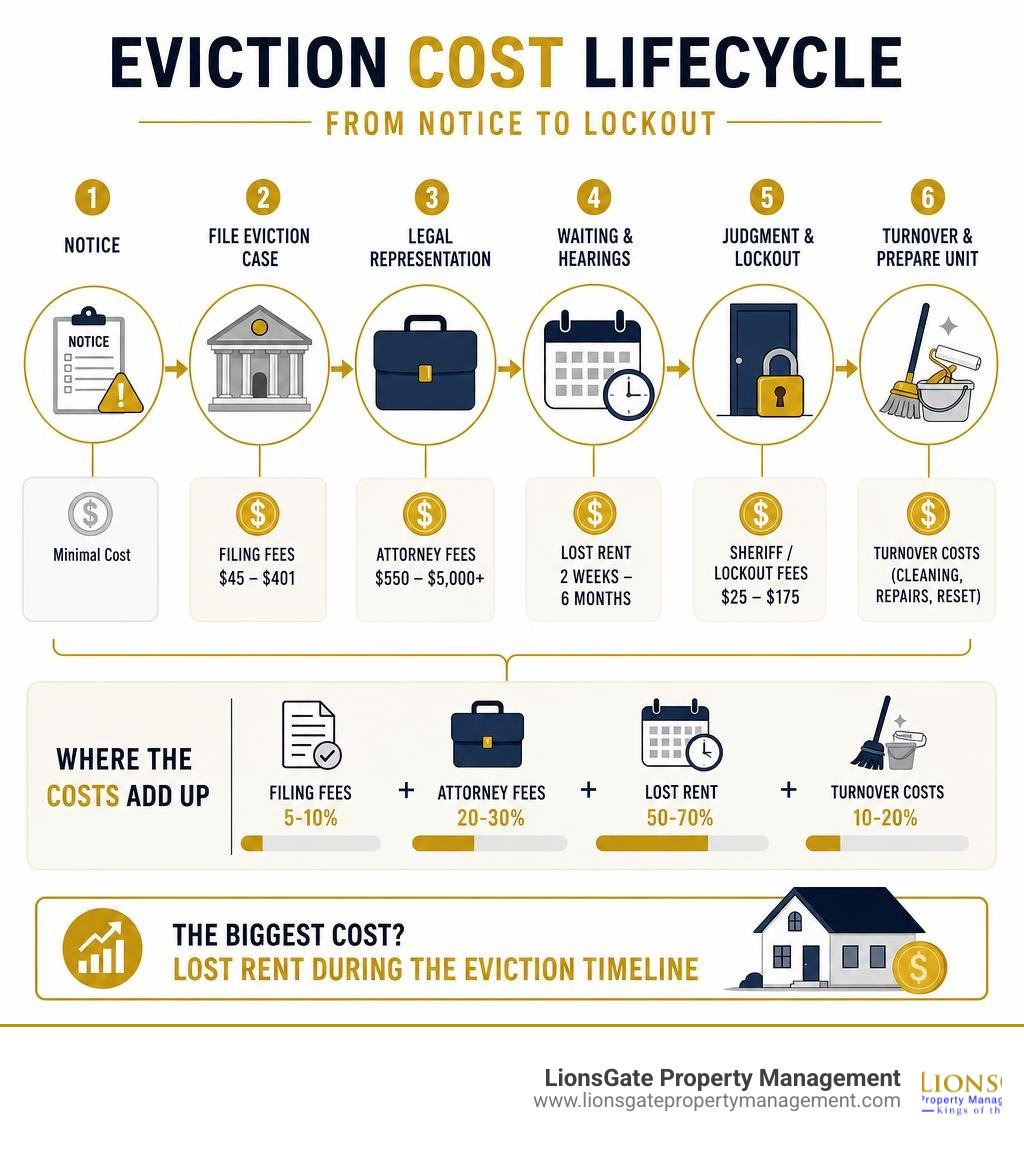
Legal fees for eviction can range from a few hundred dollars to well over $10,000 — depending on your state, whether the tenant contests the case, and how long the process drags on.
Here's a quick snapshot of what landlords typically pay:
| Cost Component | Low End | High End |
|---|---|---|
| Court filing fee | $45 (Delaware) | $401 (Florida ejectment) |
| Attorney flat fee | $550 (Florida) | $5,000+ (California) |
| Sheriff/constable lockout | $25 (Georgia) | $175 (Utah/Ohio) |
| Contested attorney fees | $500 | $3,500+ |
| Lost rent (total process) | 2–4 weeks | 3–6 months |
| Total uncontested | ~$700 | ~$4,000 |
| Total contested | ~$2,700 | ~$17,000+ |
These are estimates. Always confirm current fees with your local court and a licensed attorney.
The hard truth most landlords miss: the attorney and filing fees are rarely the biggest cost. Lost rent during the eviction timeline almost always dwarfs everything else.
I'm Isaac Spragg, founder of LionsGate Property Management — and having navigated evictions across Rhode Island's rental market, I've seen how fast legal fees for eviction spiral when landlords aren't prepared. In the sections below, I'll break down every cost so you can budget clearly and make smarter decisions.
Court Costs and Sheriff Fees Across Key States
When you start the legal eviction process, your first out-of-pocket expenses are court filing fees and service charges. These costs are highly localized. Filing a case in a tenant-friendly metro area can feel like buying a ticket to an expensive, slow-moving show, while other jurisdictions keep things relatively cheap.
Let’s look at how court filing fees, process server costs, and sheriff/constable lockout fees stack up across several states as of June 2026:
| State / Region | Court Filing Fee | Process Server / Summons | Sheriff or Constable Lockout |
|---|---|---|---|
| Florida (Pasco County) | $190 | $10 (Summons) + $40 (Server) | $90 ($115 in Miami-Dade) |
| North Carolina | $96 | $30 per person | Included in execution fees |
| Georgia | $60 – $75 | Included in standard service | $25 – $100 |
| Utah | $75 – $360 (based on damages) | $35 | $110 ($35 post + $75 lockout) |
| Delaware | $45 – $125 | Varies | $50 – $150 |
| Massachusetts | $135 (Housing Court) / $180 (District) | $50 – $150 (Constable) | $50 – $150 |
| Ohio | $160 – $250 | Varies | $50 – $175 |
| Rhode Island | $80 – $120 | $45 – $75 (Constable) | $100 – $200 |
State-Specific Nuances
- Florida: In Pasco County, a standard eviction or unlawful detainer action requires a $190 filing fee, a $10 summons issuance fee, and $40 for a process server. If you have to file an ejectment lawsuit (typically reserved for removing someone who claims an ownership interest or has an option to purchase), the filing fee jumps to $401.
- North Carolina: Effective since January 1, 2025, the baseline court cost is $96, with an additional $30 per person service fee to deliver the Summons and Complaint.
- Georgia: Filing fees for dispossessory warrants average around $60 to $75 depending on the county. Combined with service, the average total filing cost sits around $181. For a deeper look at these local numbers, check out the How Much Does an Eviction Cost in Georgia? 2026 Breakdown.
- Utah: Utah scales its filing fees based on the amount of financial damages you are claiming. If you are only seeking possession or under $2,000 in damages, the fee is $75. For damages between $2,000 and $10,000, it rises to $185, and goes up to $360 for damages over $10,000. You can read more about this in the How Much Does an Eviction Cost in Utah? 2026 Breakdown.
- Rhode Island: In our home state, evictions are handled in the District Court. Filing fees generally hover around $80 to $120, and a licensed constable must serve the tenant. For detailed local rules, refer to the Rhode Island Eviction Laws: 2026 Step by Step Process & Costs.
Understanding Legal Fees for Eviction: Flat Fee vs. Hourly Rates

When hiring an eviction attorney, you will generally encounter two types of fee structures: flat fees and hourly rates. Choosing the right structure—and understanding when a flat fee can suddenly convert into an hourly rate—is crucial to keeping your legal fees for eviction under control.
Flat-Fee Structures for Uncontested Cases
For standard, uncontested evictions, many specialized eviction attorneys offer a predictable flat fee. This means the attorney handles the drafting, filing, and standard court appearances for a single, upfront price.
- Florida Residential Evictions: Attorneys often charge a flat legal fee of $550. When you add the $190 court filing, $10 summons, and $40 process server fees, the total uncontested cost is exactly $790 from start to finish.
- Florida Unlawful Detainers: Used for removing squatters or guests who refuse to leave (where no landlord-tenant relationship exists). This also costs a flat $790 total.
- Florida Ejectments: Because these involve ownership disputes, the flat legal fee is $700, bringing the total cost to $1,151 due to the higher $401 court filing fee.
- Florida Commercial Evictions: Typically carry a slightly higher flat legal fee of $600 (totaling $840 with court costs).
- Utah Evictions: A typical flat fee for a property rights attorney is $650, which covers the standard filing. However, if the tenant files an answer, a flat $225 hearing fee is often added.
How Contested Cases Increase Legal Fees for Eviction
The moment a tenant files an answer to the eviction complaint and raises a defense, your predictable flat fee is highly likely to vanish.
When a case becomes contested, attorneys usually transition to an hourly rate—which typically ranges from $250 to $450 per hour depending on the attorney's experience and location. In Florida, for example, residential contested rates average $250/hour, while commercial cases average $275/hour.
Common tenant defenses that drag out cases and inflate hourly fees include:
- Habitability Claims: The tenant claims you failed to maintain the property (e.g., broken heating, mold, or plumbing issues) and that they withheld rent legally.
- Retaliation: The tenant claims you are evicting them because they complained to a housing authority or joined a tenant union.
- Procedural Errors: The tenant’s attorney finds a tiny technical mistake in your 3-day or 14-day notice, forcing the judge to dismiss the case and forcing you to start all over again.
In highly regulated states like Massachusetts, these contested battles can become incredibly expensive. Tenants often raise counterclaims under consumer protection laws, which can expose landlords to severe financial penalties. For a detailed breakdown of these risks, see How Much Does an Eviction Cost in Massachusetts? 2026 Breakdown.
To compare how these dynamics play out in other mid-Atlantic regions, see How Much Does an Eviction Cost in Delaware? 2026 Breakdown.
Commercial vs. Residential Legal Fees for Eviction
Commercial evictions are inherently more complex than residential ones. Commercial leases are highly customized contracts rather than standardized forms, meaning attorneys must spend hours analyzing the specific default provisions of the lease.
Furthermore, most states require business entities (like LLCs or Corporations) to be represented by a licensed attorney in court. While an individual mom-and-pop landlord might legally represent themselves pro se in some residential courts to save money, a commercial property owned under an LLC cannot. This corporate representation rule is strictly enforced in states like Ohio. You can learn more about these requirements in the How Much Does an Eviction Cost in Ohio? 2026 Breakdown.
Hidden Eviction Costs and Strategic Alternatives
If you only budget for court fees and attorney bills, you are in for a painful financial surprise. The "hidden" costs of an eviction are almost always the most expensive parts of the entire process.

The Real Cost Breakdown
- Lost Rent: This is the single largest financial hit. If your rent is $1,500 a month and the eviction takes three months to resolve, you have lost $4,500 in cash flow.
- Property Turnover & Cleaning: Angry tenants rarely leave a property in pristine condition. It is common to find trash left behind, holes in drywall, or neglected maintenance. Cleaning and repairs can easily cost between $1,000 and $5,000.
- Re-Leasing Fees: Once the property is clean, you have to pay to market it, screen new applicants, and potentially pay a leasing agent or property manager to find a qualified tenant.
If you are dealing with a tenant who has stopped paying but refuses to move, read our guide on What to Do if Tenants Don't Pay Rent and Won't Leave.
Cash-for-Keys: The Smart Landlord's Shortcut
Because litigation is expensive and slow, experienced landlords often use a strategy called "cash-for-keys."
Instead of spending $3,000 on legal fees and waiting 90 days to get your property back, you offer the tenant a financial incentive (typically $500 to $2,000) to pack up and hand over the keys voluntarily.
While it might feel deeply unsatisfying to pay a non-paying tenant to leave, the math is simple:
- Scenario A (Eviction): 3 months of lost rent ($4,500) + Legal fees ($2,000) = $6,500 loss.
- Scenario B (Cash-for-Keys): 1 month of lost rent ($1,500) + Cash incentive ($1,000) = $2,500 loss.
If you agree to a cash-for-keys settlement, never do it on a handshake. You must use a written, legally binding vacate-and-release agreement that specifies:
- The exact date and time the tenant must vacate.
- That the property must be left in "broom-clean" condition with no major damage.
- That the cash will only be handed over after a physical walkthrough and after the keys are physically returned.
- A mutual release of all claims under the lease.
For more cost-saving legal strategies, check out The Landlord's Guide to Low-Cost and No-Cost Eviction Programs.
State Statutes Governing Fee Recovery and Lease Requirements
Can you make the tenant pay for your attorney’s fees and court costs? The answer depends entirely on your state's statutes and the exact wording of your lease agreement. Without the right clauses, you will be stuck paying the bill even if you win the case.
To understand how states regulate these fees differently, you can read How Much Does an Eviction Cost in Wisconsin? 2026 Breakdown.
North Carolina (N.C. Gen. Stat. § 42-46) and Georgia (O.C.G.A. § 44-7)
In North Carolina, the law strictly regulates what administrative fees a landlord can charge. Under N.C. Gen. Stat. § 42-46, you can only charge specific fees if they are written into the lease:
- Complaint-Filing Fee: Up to 5% of the monthly rent or $15 (whichever is greater).
- Court Appearance Fee: Up to 10% of the monthly rent.
- Second Trial Fee: Up to 12% of the monthly rent.
Furthermore, recent legislative updates (Session Law 2024-47) allow landlords to recover up to 15% of the outstanding rent as attorney’s fees—but only if the lease contains a specific prevailing-party attorney's fees clause.
In Georgia, recovering legal fees also depends on a clear "prevailing party" clause in the lease. If you win a dispossessory warrant, the judge can award you court costs, but collecting those funds from a tenant who has no money is a different challenge entirely.
Utah (Utah Code § 78B-6-801) and Ohio (ORC § 5321)
Utah is incredibly strict when it comes to unlawful detainer damages. Under Utah Code § 78B-6-811, landlords are almost always awarded treble damages (triple damages) for waste, unpaid rent, or daily holdover rent after the eviction notice has expired. For example, if a tenant stays 15 days past the notice expiration and the daily rent is $30, the treble damages calculation makes them liable for $90 per day.
In Ohio, under ORC § 5321, landlords can recover actual damages and reasonable attorney's fees, but only if the tenant has breached a specific statutory obligation or if a valid lease agreement permits it. Ohio courts do not automatically award attorney's fees just because a landlord wins possession.
Massachusetts (M.G.L. c. 186) and Rhode Island Eviction Rules
Massachusetts is a highly protective jurisdiction. Under M.G.L. c. 186, landlords face severe risks. If you make a mistake with a security deposit, the tenant can countersue under Chapter 93A (the Consumer Protection Act) for triple damages plus their own attorney's fees. This means a simple non-payment eviction can turn into a massive financial liability for the landlord.
In Rhode Island, evictions are governed by the State's Landlord-Tenant Act (R.I. Gen. Laws § 34-18). Landlords can recover reasonable attorney's fees and court costs if the tenant's noncompliance is willful. To protect yourself, your lease must include a clear clause stating that the tenant is responsible for all legal costs, court fees, and constable service fees incurred during an eviction action.
For step-by-step guidance on navigating local courts in Rhode Island, read our comprehensive guide on District Court Landlord/Tenant Evictions - Rhode Island Judiciary or explore our local resource on How to Handle Evictions in Providence and Beyond.
Frequently Asked Questions about Eviction Costs
Who pays the court filing fees during an eviction?
The landlord must pay all court filing and service fees upfront. If you win the eviction lawsuit, the judge will typically award you a judgment that includes these court costs, making the tenant legally responsible for reimbursing you. However, collecting on an eviction judgment is notoriously difficult because tenants who are evicted for non-payment rarely have garnishable wages or visible assets.
How long does a contested eviction take compared to an uncontested one?
An uncontested eviction (where the tenant does not respond or move out) typically takes 14 to 45 days from the initial notice to the physical lockout, depending on the state. A contested eviction (where the tenant hires an attorney, files counterclaims, or requests hearings) can easily drag on for 90 to 180 days, or even longer in tenant-friendly states with severe court backlogs.
Does landlord insurance cover legal fees for eviction?
Standard landlord property and liability insurance policies do not cover eviction legal fees or lost rent. Some insurance carriers offer specialized "rent guarantee" or "eviction expense" endorsements, but these must be purchased as add-ons before a tenant defaults. Even then, they typically exclude coverage if the tenant had pre-existing payment issues.
Conclusion
At the end of the day, the best way to cut down on legal fees for eviction is to avoid evictions entirely. Every dollar you invest in rigorous tenant screening—such as verifying employment, running credit checks, and calling previous landlords—saves you thousands of dollars in future legal battles and empty units.
But if you do find yourself dealing with a non-paying tenant, speed is your greatest asset. Delaying the process only increases your lost rent.
If you own rental property in Providence, Cranston, Warwick, Pawtucket, North Providence, or East Providence, you don't have to deal with this stress alone. At LionsGate Property Management, we handle the hard work for you. We manage duplexes, triplexes, and small-to-mid-size apartment buildings with a focus on a stress-free ownership experience.
Our clients love our unique guarantees, including proactive maintenance, reliable snow removal, and our signature no-cost eviction program. If a tenant we screen and place ever needs to be evicted, we cover the legal fees and court costs so your investment remains protected.
To learn more about protecting your rental business, check out our guide on What to Do if Tenants Don't Pay Rent and Won't Leave, or contact us today to see how we can make your rental property truly passive.