
How to Navigate the Tenant Eviction Process

What Every Landlord Needs to Know About Tenant Eviction
Tenant eviction is the legal process a landlord must follow to remove a tenant from a rental property. It involves several steps — from written notice to court filing to physical removal — and each step has strict rules and deadlines.
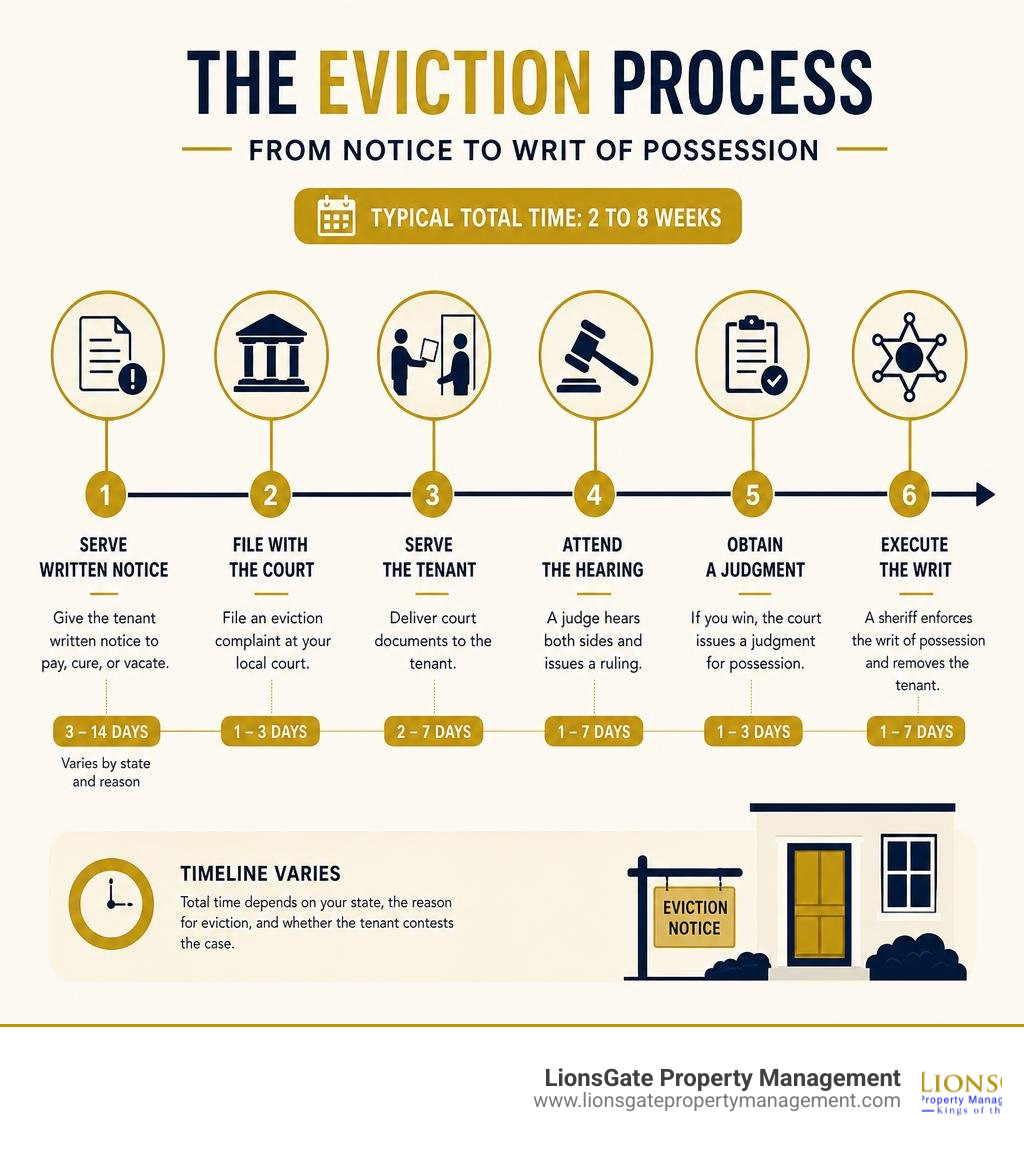
Here's a quick overview of how a standard eviction works:
- Serve written notice — Give the tenant a written notice to pay, cure a violation, or vacate (timeline varies by state and reason)
- File with the court — If the tenant doesn't comply, file an eviction complaint at your local court
- Serve the tenant — Formally deliver court documents to the tenant within required deadlines
- Attend the hearing — A judge hears both sides and issues a ruling
- Obtain a judgment — If you win, the court issues a judgment for possession
- Execute the writ — A sheriff or constable enforces the writ of possession and removes the tenant
The full process typically takes 2 to 8 weeks depending on your state, the reason for eviction, and whether the tenant contests the case.
Eviction is one of the most stressful situations a landlord can face. In 2023 alone, there were approximately 3.6 million eviction filings across the United States — roughly 1 in every 50 renter households. Non-payment of rent drives the vast majority of those cases, accounting for 70–80% of all filings in most states.
For small landlords managing duplexes or triplexes, a single non-paying tenant can quickly eat through months of rental income. And if you make even one procedural mistake along the way — wrong notice period, improper service, missing a deadline — a judge can dismiss your case entirely, forcing you to start over.
That's why understanding the process before you need it is so important.
I'm Isaac Spragg, founder of LionsGate Property Management, and I've navigated the tenant eviction process — both as a rental property owner and as a property manager serving landlords across Providence, Cranston, Warwick, and Pawtucket, Rhode Island. In this guide, I'll walk you through every stage of the process clearly and practically, so you know exactly what to expect and how to protect your investment.
Understanding the Legal Grounds for a Tenant Eviction
Before you can take any legal action to reclaim your rental property, you must have valid, legally recognized grounds to do so. Landlords cannot simply decide to end a tenancy on a whim mid-lease. Every step must be backed by a specific contractual or legal violation, or the proper expiration of a tenancy agreement.
Non-Payment of Rent vs. Lease Violations in a Tenant Eviction
While non-payment of rent is the most common reason for a tenant eviction, it is far from the only one. The law treats rent arrears and other lease violations quite differently, particularly when it comes to the type of notice you must serve and the opportunity your tenant has to correct the issue.
- Non-Payment of Rent: When rent is late, you have clear monetary grounds to act. In Rhode Island, for instance, once rent is more than 15 days past due, you can issue a 5-day demand notice. If the tenant pays the full balance within those 5 days, the eviction process stops. If you are dealing with a tenant who consistently fails to pay and refuses to communicate, check out our guide on What to Do If Tenants Don’t Pay Rent and Won’t Leave.
- Lease Violations (Material Breaches): These include issues like severe property damage, keeping unauthorized pets, hosting long-term unauthorized occupants, or disturbing the peace (nuisance). For these violations, you typically must serve a notice detailing the breach and giving the tenant a specific window of time to "cure" (fix) the problem. If they cure the issue—such as rehoming the unauthorized dog—the lease remains in effect. If they fail to do so, you can proceed with the eviction.
No-Cause Terminations and Just Cause Ordinances
When a lease naturally expires or when a tenancy is month-to-month, a landlord can often end the relationship without needing to prove a lease violation. This is known as a "no-cause" termination. Typically, this requires serving a 30-day or 60-day written notice to vacate depending on the length of the tenancy.
However, the legal landscape has shifted dramatically in recent years. Many major metropolitan areas and some states have enacted "Just Cause" ordinances. Under these rules, even if a lease has ended, a landlord cannot terminate a tenancy or refuse a lease renewal unless they have an approved "just cause."
For example, in California, the Tenant Protection Act (AB 1482) restricts no-cause evictions for many properties. Additionally, cities like Los Angeles have implemented strict Just Cause Ordinances (JCO) that require landlords to have at-fault reasons (such as non-payment or lease violations) or approved no-fault reasons (such as owner move-in or property demolition). If you execute a no-fault eviction under these jurisdictions, you may be legally required to pay substantial relocation assistance to the tenant. While Rhode Island does not currently have a statewide Just Cause law for all private tenancies, local housing policies are constantly evolving, making it essential to work with a local property management team that stays ahead of local ordinances.
Step-by-Step Guide to the Eviction Process and Timelines
Eviction is a strictly procedural area of law. Judges will not hesitate to throw a case out of court if a landlord missed a deadline by a single day or used the wrong delivery method. Understanding the exact costs and steps involved is crucial. If you're wondering about the financial impact of this process, read our detailed breakdown on How Much Does It Cost to Evict a Tenant.

Step 1: Serving the Proper Written Notice
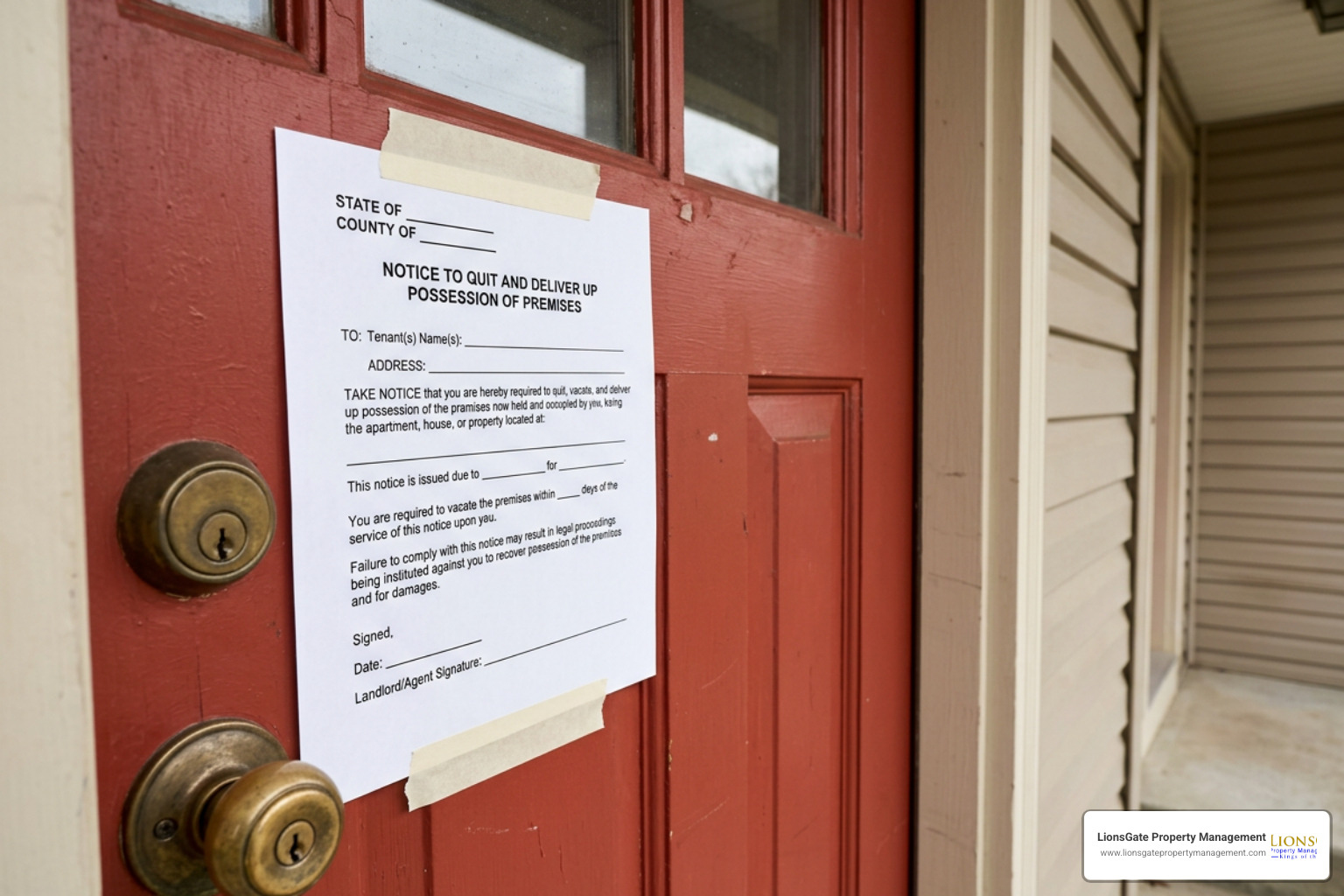
The entire process officially begins with a written notice. You cannot file a lawsuit in court until you have served the correct notice and the required timeframe has expired without resolution.
Depending on where your property is located and the nature of the violation, this notice might be called a Notice to Quit, a Demand for Compliance, or a Notice to Pay or Vacate.
- For non-payment of rent, notices typically range from 3-day demands (like in Texas) to 14-day demands (common in Minnesota and other states).
- The service method is just as important as the document itself. In many jurisdictions, you must deliver the notice directly to the tenant, leave it with a suitable household member, or send it via certified mail. Sliding the notice under the door or taping it to the front gate without following statutory backup steps can render the notice legally void. For a look at how strict these service guidelines can be, you can examine the instructions for Michigan's INSTDC 100c, Instructions for Notice to Quit to Recover Possession of Property, Landlord-Tenant.
Step 2: Filing the Eviction Lawsuit in Court
If the notice period expires and the tenant has neither paid the rent nor moved out, you must take the dispute to court. This is often called a Forcible Entry and Detainer (FED) action or an Eviction Action Complaint.
To file the lawsuit, you must submit the complaint and a summons to your local court clerk and pay the required filing fees. The complaint must outline the details of the tenancy, the specific violation, and proof that the initial notice was served correctly. For example, Minnesota's Instructions - Eviction Action Complaint (HOU101) show that landlords must attach the written lease and a copy of the pre-eviction notice to the court filings to avoid immediate dismissal.
Once filed, the court will set a hearing date and issue a summons. This summons must be formally served to the tenant—usually by a sheriff, constable, or licensed process server—at least a specified number of days before the scheduled court date.
Step 3: The Tenant's Right to Respond and Prepare for Court
Tenants have a constitutional right to due process, meaning they must be given a fair opportunity to respond to the lawsuit.
Depending on the state, a tenant may be required to file a written Answer or an Appearance form with the court before the hearing date to avoid a default judgment.
- In some jurisdictions, the tenant must submit this response within 5 to 10 days of being served with the summons.
- In other states, the tenant simply needs to show up at the designated "return date" or initial hearing to voice their defense.
- Tenants can raise various defenses, such as claiming the landlord failed to maintain the property in a habitable condition, refused to accept a valid rent payment, or failed to serve the notice correctly. To understand how courts structure these responses, you can look at the JDF 100 - Guide to Residential Evictions from the Colorado Judicial Branch, which details how tenants can file answers and even request remote participation.
What Happens During a Tenant Eviction Hearing and Judgment
The eviction hearing is where both parties present their arguments and evidence to a judge. It is not an informal chat; it is a formal legal proceeding where the rules of evidence apply.
Navigating the Courtroom, Mediation, and Appeals
When you arrive at court, the judge will typically call the docket. In many Rhode Island courts, including the District Court in Providence, the parties are strongly encouraged—and sometimes required—to meet with a court-appointed mediator before the judge hears the case. Mediation is often the fastest, cheapest way to resolve a dispute. You might agree to a structured payment plan or a "cash for keys" settlement where the tenant agrees to vacate voluntarily by a specific date in exchange for a clean record.
If mediation fails, the case goes to trial. You must bring all your evidence: the signed lease, payment ledgers, communication records, photos of property damage, and proof of notice service.
If the judge rules in your favor, they will issue a judgment for possession. However, the tenant still has legal options:
- Appeals: In states like Texas, the tenant has a strict 5-day window to appeal the judgment. In other areas, the appeal window might be 7 to 21 days. To appeal, the tenant usually must post an appeal bond, which often equals the amount of rent owed.
- Discretionary Stays: In some states, like New Hampshire, a tenant who loses an eviction hearing can ask the judge for a discretionary stay of execution for up to 90 days if they can demonstrate extreme hardship and actively look for alternative housing.
For a deeper dive into managing this court process locally, read our guide on How to Handle Evictions in Providence and Beyond.
Executing the Writ of Possession and Finalizing a Tenant Eviction
Winning a court case does not give you the right to change the locks or throw the tenant’s belongings onto the curb. Doing so is an illegal "self-help" eviction and can result in severe financial penalties.
To legally regain physical possession of your property, you must request a Writ of Possession (sometimes called a Writ of Restitution) from the court clerk after the appeal window has closed.
This writ is a direct order to the local sheriff or constable to remove the tenant. The officer will typically post a final warning on the tenant's door, giving them 24 to 72 hours to pack up and leave. If the tenant is still present when the officer returns, the officer will physically remove them.
What about their belongings? State laws vary wildly on this. Some states require the landlord to pay to move and store the tenant's personal property in a licensed warehouse for a certain period (such as 7 days in New Hampshire). In other states, the sheriff will simply oversee the removal of the items to the property line.
State-by-State and International Procedural Differences
Eviction laws are highly localized. What takes two weeks in one jurisdiction can easily take several months in another. The table below highlights some of the key differences in timelines and notice requirements across various states and international regions.
| Jurisdiction | Notice Period (Non-Payment) | Typical Time (Filing to Hearing) | Tenant Appeal Window | Key Procedural Characteristic |
|---|---|---|---|---|
| Rhode Island | 5-Day Demand (after 15 days late) | 10–20 days | 5 days | Mediation heavily encouraged in District Court. |
| Texas | 3-Day Notice to Vacate | 10–21 days | 5 days | Fast-paced process; strict enforcement of property codes. |
| California | 3-Day Notice to Pay or Quit | 30–45+ days | 5–10 days | Highly tenant-friendly; Just Cause ordinances apply. |
| New Mexico | 3-Day Notice to Pay or Quit | 10–15 days | 5 days | Strict documentation of notice service required. |
| Oregon | 10-Day Notice (or 72-Hour) | 7–15 days | N/A (Immediate Writ) | Landlord must include specific veterans' info on notices. |
| Minnesota | 14-Day Written Notice | 7–14 days | 10 days | Specialized Housing Courts in Hennepin and Ramsey. |
| England (UK) | Section 8 Notice (varies) | 4–8 weeks | 21 days | Section 21 "no-fault" evictions abolished post-2025. |
Comparing Eviction Laws Across Key U.S. Jurisdictions
Let's look at how some of these state laws function in practice:
- Oregon: Evictions are formally called Forcible Entry and Detainer (FED) actions. Landlords must strictly follow the statutes outlined in the FED Landlord Instruction, which include providing a Declaration of Non-Military Service and serving the tenant by the end of the next judicial day after filing.
- Minnesota: Under Minnesota Statute Chapter 504B, landlords must provide a 14-day written notice before filing a non-payment eviction. The state also offers a "pay and stay" redemption right, allowing tenants to stop the eviction by paying the past-due rent plus limited court costs at the hearing.
- Rhode Island: Eviction actions are handled through the Rhode Island District Court system. Landlords must file specific complaints depending on whether the action is for non-payment, lease violations, or holdover tenancies. You can review the official court forms and guidelines on the Landlord/Tenant Evictions - District Court portal.
The Post-2026 Eviction Landscape in England
For landlords with international portfolios or those interested in global real estate trends, the United Kingdom has undergone a massive regulatory shift. Following the implementation of the Renters’ Rights Act 2025, Section 21 "no-fault" evictions were completely abolished in England.
Landlords seeking possession must now use a Section 8 notice under the Housing Act 1988 by completing Form 3A. Possession can only be granted based on specific "mandatory" grounds (such as the landlord wanting to sell the property or severe rent arrears) or "discretionary" grounds (such as minor breaches of the tenancy agreement). Furthermore, landlords must strictly comply with deposit protection schemes to use these grounds. For more details on these post-2026 rules, see the official UK guidance on Repossessing your privately rented property after 1 May 2026 - GOV.UK and Evicting tenants in England: Giving notice to evict tenants - GOV.UK.
Frequently Asked Questions about Tenant Eviction
What happens if a landlord fails to follow proper eviction procedures?
If a landlord attempts to bypass the legal court process—such as by changing the locks, shutting off utilities, or removing the tenant's belongings—they are committing an illegal lockout. In almost every jurisdiction, this is considered tenant harassment or wrongful removal.
The tenant can sue the landlord for damages, and judges will often dismiss the eviction case immediately, forcing the landlord to pay the tenant's legal fees and start the entire notice process over from scratch.
How does the CARES Act or public housing subsidies affect evictions?
If your rental property is backed by a federal mortgage (such as Fannie Mae or Freddie Mac) or if you accept Section 8 housing vouchers, you must comply with additional federal guidelines.
For instance, the federal CARES Act requires a 30-day notice to vacate for non-payment of rent on covered properties, overriding shorter state timelines. Furthermore, public housing tenants often have a right to administrative grievance hearings before an eviction lawsuit can even be filed in court.
Where can tenants and landlords find financial or legal assistance?
Eviction is a stressful and expensive process for everyone involved. Fortunately, there are several local programs designed to help stabilize tenancies and provide legal aid:
- For Tenants: Legal aid organizations can assist with court representation and help file fee waivers for court costs. Tenants can access local guidance via the Eviction FAQ for Tenants - Homes RI and track broader trends through the Providence, RI | Eviction Tracking database.
- For Landlords: Navigating these filings alone is risky. You can find qualified local representation by browsing the Best Landlord Tenant Lawyers in Cranston, RI - Justia directory.
- Local Assistance Programs: If you are operating in Rhode Island, there are excellent resources available to help resolve rent arrears before they escalate to a lawsuit. Read our guides on:
Conclusion
Managing a tenant eviction is one of the most challenging aspects of property ownership. From serving the first notice to navigating District Court mediation and executing a writ of possession, the legal margin for error is razor-thin.
At LionsGate Property Management, we believe that Rhode Island landlords shouldn't have to deal with the stress, sleepless nights, and lost income that come with a difficult tenancy. We offer full-service rental property management for duplexes, triplexes, and mid-sized apartment buildings across Providence, Cranston, Warwick, Pawtucket, and North Providence.
Our unique management model delivers a truly stress-free ownership experience. We offer guaranteed rent, proactive maintenance to protect your property, seasonal snow removal, and our signature no-cost evictions guarantee. If a tenant we place needs to be evicted, we handle the entire legal process and cover the costs so you don't have to.
If you are currently facing a difficult rental situation, don't wait for rent arrears to pile up. Read our comprehensive guide on What to Do If Tenants Don’t Pay Rent and Won’t Leave, or reach out to our team today to learn how we can protect your investment and restore your peace of mind.