
Everything You Need to Know About Rent Guarantees from Pawtucket to Warwick

What Is the Cranston Rent Guarantee Program — and Do You Qualify?
The cranston rent guarantee program is part of a broader set of housing tools designed to reduce risk for landlords while helping low-income tenants access stable housing in the private market.
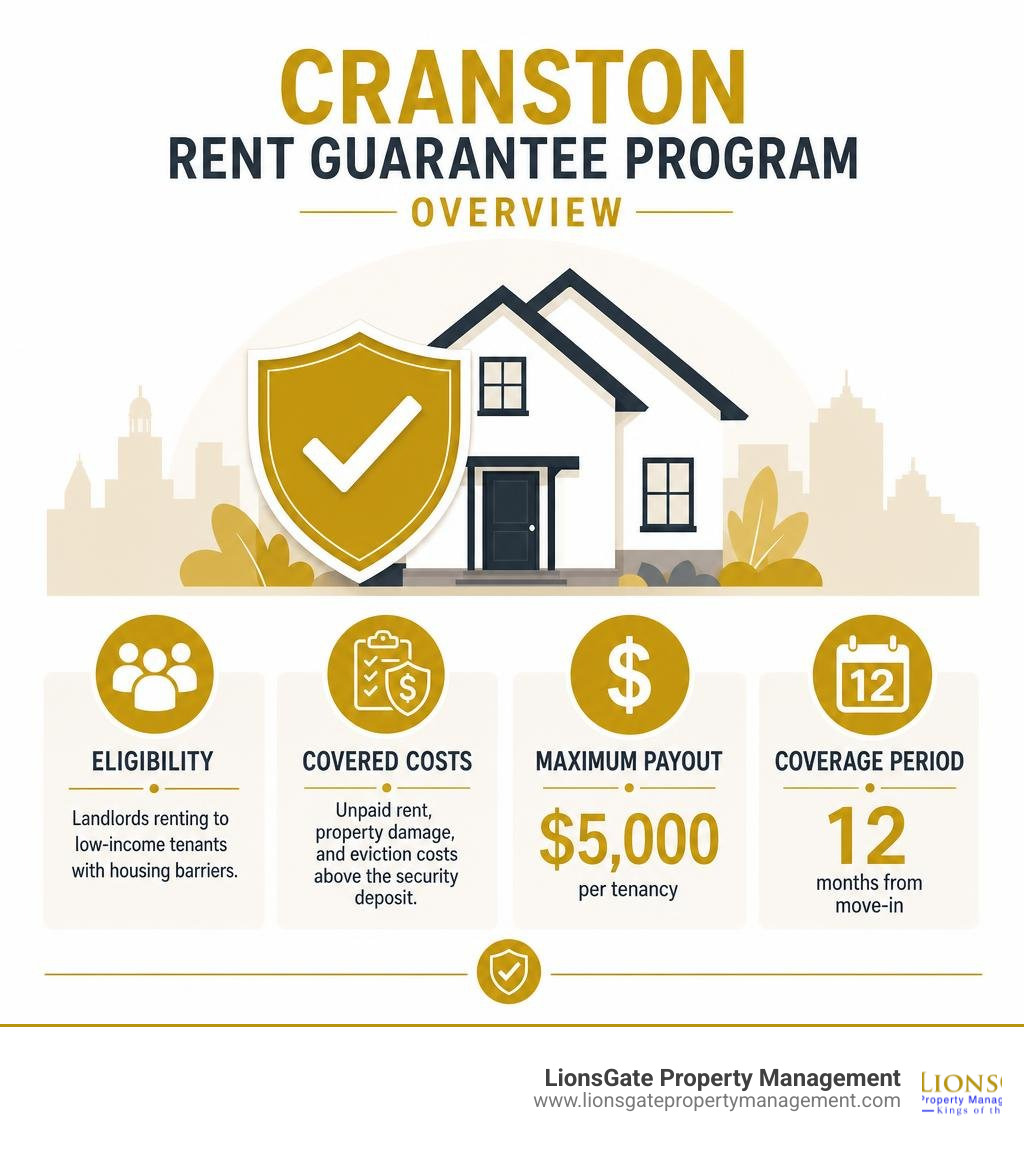
Here's a quick summary of how it works:
| Feature | Details |
|---|---|
| Who it helps | Landlords renting to low-income tenants with housing barriers |
| Tenant income limit | Up to 60% of Area Median Income (AMI) |
| What it covers | Unpaid rent, property damage, eviction costs (above security deposit) |
| Maximum payout | $5,000 per tenancy |
| Coverage period | First 12 months of tenancy |
| Tenant requirement | Must complete a Tenant Readiness Education course (certificate valid 18 months) |
| Landlord requirement | Must sign a Provider/Landlord Agreement within 60 days of move-in |
Cranston landlords managing duplexes or small apartment buildings often face the same core fear: what happens if a tenant stops paying or causes damage? That's exactly the gap this type of program is built to close.
Cranston sits within a busy rental market supported by the Cranston Housing Authority, which administers 262 Section 8 vouchers and owns 586 public housing units. Combine that with federal CDBG funding and community support through organizations like CCAP — and there's a real safety net forming around Cranston renters and the landlords who house them. But navigating all of it isn't always simple.
I'm Isaac Spragg, founder of LionsGate Property Management, and I've worked hands-on managing rental properties across Providence, Cranston, and the surrounding Rhode Island market — including helping landlords understand and access rent guarantee protections like those covered in this guide. Keep reading for a complete breakdown of how the cranston rent guarantee program works, who qualifies, and how to get the most out of it.
Understanding Rent Guarantees in Rhode Island

For property owners in Rhode Island, protecting cash flow is the foundation of a successful investment. When you lease out a property, you are taking on a calculated risk. A rent guarantee is a risk-mitigation tool designed to ensure that you still receive your rental income even if your tenant experiences a financial crisis.
But what exactly is a rent guarantee, and how does it differ from traditional landlord insurance? To understand the landscape, it helps to read our breakdown on What Is Guaranteed Rent and Why Should You Care. Essentially, while standard insurance covers catastrophic physical damage, a rent guarantee focuses on protecting your monthly rental income.
In Rhode Island, rent guarantees can take a few different forms. Some are private management programs, some are insurance-backed policies, and others are government-sponsored initiatives. For a complete look at these options, check out the A-Z Guide to Landlord Rent Guarantee and our deep dive on how to Protect Your ROI with Guaranteed Rent Insurance.
For many local property owners, the absolute best-case scenario is finding a reliable way to secure consistent monthly payments without the headache of chasing down tenants. This is often referred to as The Landlord's Dream: Guaranteed Rent in Providence and Cranston. By utilizing these programs, you can eliminate the stress of missed payments and focus on growing your portfolio.
The Local Housing Landscape in Cranston
To understand why the cranston rent guarantee program is so crucial in July 2026, we have to look at the local housing landscape. Cranston is a thriving city with a diverse rental market, but many residents face housing affordability challenges.
The Cranston Housing Authority plays a massive role in the local community. It owns and operates 586 public housing apartments designated for elderly and disabled residents across six buildings. Additionally, the authority administers 262 tenant-based Section 8 Vouchers (Housing Choice Voucher Program) to help low-income families rent units in the private market.
To support these housing initiatives, the City of Cranston utilizes federal resources. For the fiscal year, the city was awarded a Community Development Block Grant (CDBG) from HUD in the amount of $1,061,374.00. These funds help support local programs, including housing rehabilitation and emergency assistance. You can learn more about these initiatives directly from the Cranston Community Development page.
Local community action programs also step in to help. The Comprehensive Community Action Program (CCAP) serves over 40,000 people annually with a $41 million agency budget across 92 programs. From energy assistance to emergency housing support, CCAP is a vital resource for keeping Cranston families housed.
Navigating the Cranston Rent Guarantee Program in 2026

The cranston rent guarantee program is designed to encourage private landlords to rent to individuals who might otherwise be screened out due to poor credit, a past eviction, or a lack of rental history. By offering a financial safety net to landlords, the city helps open up housing opportunities for vulnerable residents while protecting the financial interests of property owners.
This local program shares many operational structures with highly successful state-level models across the country, such as the Rent Guarantee Program (RGP) framework. The core philosophy is simple: if a landlord agrees to lower their screening barriers for a certified tenant, the program will guarantee financial reimbursement for specific losses incurred during the first year of the tenancy.
Eligibility Criteria for the Cranston Rent Guarantee Program
To participate in the program, both the tenant and the landlord must meet specific eligibility requirements:
- Income Limits: The tenant's household income must not exceed 60% of the Area Median Income (AMI) based on HUD guidelines. For context, according to the Rhode Island Rental Resource Guide, the 50% AMI limit for a single-person household in Cranston is approximately $33,850, meaning the 60% limit expands eligibility slightly to cover working-class individuals and families who need a helping hand.
- Housing Barriers: Eligible tenants typically present one or more housing barriers, such as a lack of rental history, a low credit score, or past housing instability.
- Tenant Readiness Certification: Before a tenant can utilize the guarantee, they must complete an approved tenant education course, such as the "Rent Well" curriculum or a local equivalent. This course teaches tenants about lease compliance, budgeting, and landlord-tenant relations. Upon graduation, they receive a certificate that is valid for 18 months.
Covered Costs and Financial Limits
If an eligible tenant defaults on their lease or causes damage, the program provides robust financial protection for the landlord. However, there are strict limits on what can be claimed:
- Maximum Financial Assistance: The program will pay out a maximum of $5,000 per tenancy.
- Time Limits: The guarantee only covers eligible expenses incurred during the first 12 months of the tenancy.
- Allowable Expenses: Landlords can claim reimbursement for unpaid rent, physical property damage beyond normal wear and tear, and legal costs associated with an eviction.
- The Security Deposit Rule: The program only covers expenses that exceed the tenant's security deposit. Landlords must first apply the tenant's security deposit to any outstanding balances before submitting a claim to the program.
How Landlords Can Apply and Register for the Cranston Rent Guarantee Program
To secure this protection, landlords must follow a specific procedural timeline:
- Sign the Agreement: Once you select an eligible, certified tenant, you must execute a Provider/Landlord Agreement. This document must be signed and submitted within 60 days of the tenant's move-in date.
- Maintain Documentation: Keep meticulous records, including the initial move-in inspection report, photos of the property condition, rent ledgers, and copies of all communications.
- Submit a Claim: If the tenant vacates the property within the first 12 months and leaves behind unpaid rent or damages, you must submit a claim for reimbursement. This claim must be filed within 30 days of the tenant vacating the unit.
- Provide Proof: Your claim must include proof that the security deposit was fully utilized, itemized receipts for repairs, and a copy of the rent ledger showing the unpaid balance.
For a detailed look at how to handle these situations step-by-step, check out our guide on No More Missed Payments: A Landlord's Guide to Rent Guarantee Coverage.
How Government Programs Interact with Local Housing Authorities
Navigating the intersection of local, state, and federal housing programs can be challenging for private landlords. However, understanding how these programs work together is key to maximizing your rental income and staying compliant with local laws. If you own rental property in the area, partnering with an expert who specializes in Property Management Services Cranston can make this coordination seamless.
Coordination with Section 8 and Public Housing
In Cranston, many low-income tenants rely on federal Housing Choice Vouchers (Section 8) administered by the Cranston Housing Authority. These vouchers pay a significant portion of the tenant's rent directly to the landlord, while the tenant pays the remaining 30-40% of their gross income.
It is important to note that Rhode Island fair housing law strictly prohibits discrimination based on a tenant's source of income. This means landlords cannot refuse to rent to a tenant simply because they use a Section 8 voucher.
The cranston rent guarantee program can be layered with Section 8 vouchers. For example, if a Section 8 tenant has a poor credit history, the rent guarantee program can provide the landlord with the extra security needed to approve the application, covering any unpaid tenant-portion rent or damages during the first year.
Additionally, community organizations like CCAP offer local support that integrates with housing stability. For instance, CCAP's Low Income Home Energy Assistance Program (LIHEAP) helps low-income renters pay their heating bills, reducing the risk of utility shut-offs and financial strain. Landlords should encourage tenants to apply for LIHEAP; applications open annually on October 1 and close on April 15. You can find more details about these resources on the CCAP Food Bank, Housing, & Fuel Assistance for Disadvantaged Residents page.
For tenants facing immediate eviction crises, initiatives like RentReliefRI have historically provided on-the-ground support. You can read more about these efforts on the RentReliefRI Provides On-the-Ground Support for Rhode Islanders ... news release.
Frequently Asked Questions about Rhode Island Rental Assistance
What is the maximum payout under the rent guarantee program?
The maximum financial assistance available under the program is $5,000 per tenancy. This fund is designed to cover allowable expenses—such as unpaid rent, eviction costs, and physical property damage—that exceed the tenant's security deposit during the first 12 months of the lease.
How long is the tenant readiness certification valid?
The tenant readiness certificate (such as the Rent Well certificate) is valid for exactly 18 months from the date of course completion. If a tenant does not secure housing within this window, they may need to retake the course or seek an extension to remain eligible for the guarantee.
Are there any recent updates to Cranston housing funding for 2026?
For the 2025-2026 period, Cranston continues to leverage its federal CDBG allocation to fund community development and housing rehabilitation. While municipal budgets are tightly allocated, programs supporting affordable housing remain a priority. Landlords should stay in close contact with local housing administrators to monitor real-time funding availability and any changes to local caps.
Conclusion
Navigating rental properties in Rhode Island doesn't have to be a stressful, high-risk endeavor. Whether you are Managing Cranston Duplexes Like a Pro, looking for help with Taking Care of Cranston Multi-Family Properties Without the Headache, or trying to figure out How to Choose the Best Mid-Size Apartment Management in Cranston RI, we are here to support you.
For landlords who want a comprehensive list of rent protection options, we've compiled The Ultimate Guaranteed Rent Program Roundup and a practical guide on How Rhode Island Landlords Can Guarantee Their Monthly Rent.
At LionsGate Property Management, we provide full-service rental management for duplexes, triplexes, and small-to-mid-size apartment buildings across Providence, Cranston, Warwick, Pawtucket, and North Providence. We deliver a truly stress-free ownership experience by offering guaranteed rent, proactive maintenance, prompt snow removal, and no-cost evictions.
Ready to protect your rental income and eliminate vacancy stress? Learn more about our signature Guaranteed Rent Program Providence and discover how we can help you secure your investment today.