
Providence Fair Housing and Equal Opportunity Programs Explained

What Providence Fair Housing Laws Mean for Landlords and Renters
Providence fair housing law protects residents from discrimination at every stage of renting, buying, or financing a home. Whether you're a renter looking for help or a landlord trying to stay compliant, knowing your rights and responsibilities matters.
Here's a quick overview of who is protected and where to get help:
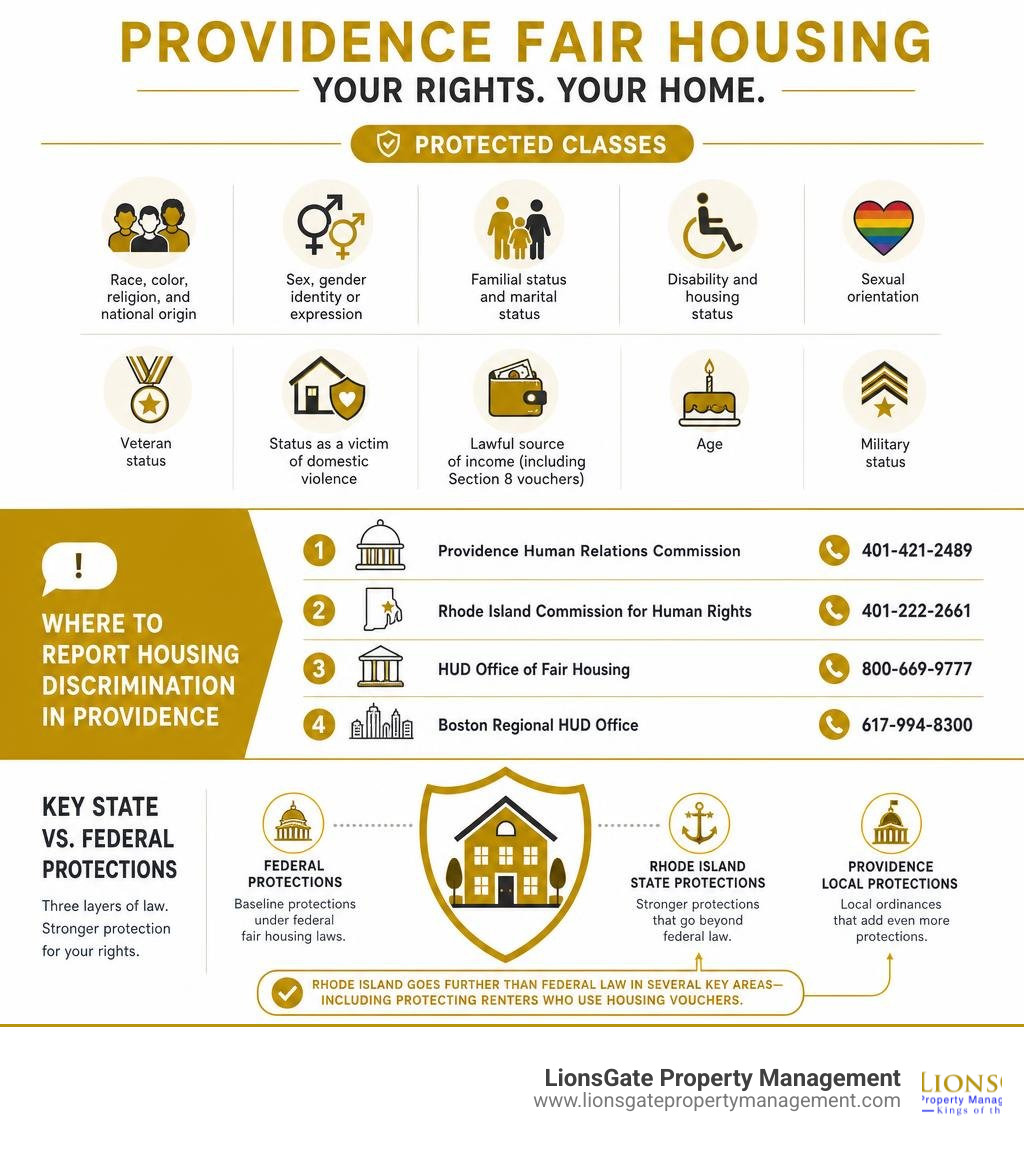
Protected classes in Providence housing:
- Race, color, religion, and national origin
- Sex, gender identity or expression
- Familial status and marital status
- Disability and housing status
- Sexual orientation
- Veteran status
- Status as a victim of domestic violence
- Lawful source of income (including Section 8 vouchers)
- Age and military status
Where to report housing discrimination in Providence:
- Providence Human Relations Commission — call 401-421-2489
- Rhode Island Commission for Human Rights — call 401-222-2661
- HUD Office of Fair Housing — call 800-669-9777
- Boston Regional HUD Office — call 617-994-8300
Fair housing in Providence is shaped by three layers of law: federal, state, and local. Each layer adds protections. Rhode Island goes further than federal law in several key areas — including protecting renters who use housing vouchers.
I'm Isaac Spragg, founder of LionsGate Property Management, and through hands-on experience managing rental properties across Providence and surrounding Rhode Island markets, I've helped landlords navigate Providence fair housing compliance without the guesswork. In this guide, I'll break down exactly what the law requires — and what it means for your rental business.
Federal vs. Rhode Island State Protections: Understanding Providence Fair Housing
To truly understand how Providence fair housing rules apply to your local multi-family building, we have to look at how different levels of government work together.
The baseline is the federal Fair Housing Act, which was passed in 1968. It bars discrimination in housing transactions based on seven protected classes. But because Rhode Island has no county government—meaning municipal and state laws hold all local regulatory power—the state has stepped up to add several extra layers of protection.
Under the Rhode Island Fair Housing Practices Act, the state adds nine additional protected classes to the federal baseline. When we operate in cities like Providence, Cranston, Warwick, Pawtucket, or North Providence, we must adhere to the strictest level of protection available, which is always the combination of state and local rules.
| Protected Class | Protected Under Federal Law? | Protected Under Rhode Island Law? |
|---|---|---|
| Race & Color | Yes | Yes |
| National Origin / Ancestral Origin | Yes | Yes |
| Religion | Yes | Yes |
| Sex (including Pregnancy) | Yes | Yes |
| Familial Status (having children under 18) | Yes | Yes |
| Disability (Physical or Mental) | Yes | Yes |
| Age | No | Yes |
| Marital Status | No | Yes |
| Sexual Orientation | No | Yes |
| Gender Identity & Expression | No | Yes |
| Military Status / Honorable Discharge Veteran | No | Yes |
| Status as a Victim of Domestic Abuse | No | Yes |
| Lawful Source of Income (e.g., Section 8) | No | Yes |
| Housing Status (e.g., experiencing homelessness) | No | Yes |
As you can see, Rhode Island offers one of the most comprehensive lists of protected classes in the country. If you are managing or renting property in the area, you can learn more about these local nuances by visiting the Fair Housing - Town of North Providence, Rhode Island information page.
Source of Income Discrimination and the Fair Housing Practices Act
One of the most significant shifts in Rhode Island real estate occurred when Governor Dan McKee signed the Fair Housing Practices Act into law in 2021. This legislation officially added "lawful source of income" as a protected class statewide.
Before this law passed, landlords could legally include "No Section 8" in their rental listings. Today, doing so is a major violation of Providence fair housing guidelines. Rhode Island joined 15 other states, Washington D.C., and nearly 100 municipalities across the country in banning this practice.

What Counts as a Lawful Source of Income?
Under the law, landlords cannot reject an applicant simply because their rent money comes from sources other than a traditional weekly paycheck. Lawful sources of income include:
- Section 8 Housing Choice Vouchers
- Social Security and Supplemental Security Income (SSI)
- Child support and alimony
- Public assistance or temporary disability benefits
- Veterans’ benefits or pension programs
If a voucher program or subsidy covers a portion of the rent, a landlord must evaluate the tenant's income eligibility based only on the tenant's individual portion of the rent, rather than the entire monthly rental amount. Reversing this rule to reject a voucher holder is considered a pretext for discrimination.
The Owner-Occupied Exception
There is a narrow exemption written into the state law. An owner may reject an applicant based on their source of income if:
- The rental property has three or fewer units.
- The owner actually lives in one of those units as their primary residence.
If you own a duplex or triplex and live in one of the units, you are legally permitted to make a personal decision regarding source of income. However, if you own a four-unit building, or if you do not live in your duplex, you must comply fully with the source of income protections. For more tips on managing small apartment buildings in the local market, check out our guide on Providence Small Apartment Rental Secrets for Savvy Tenants.
How Local Housing Authorities Implement Fair Housing Policies
Local housing authorities play a vital role in putting Providence fair housing policies into action. Agencies like the Providence Housing Authority (PHA) and the Cranston Housing Authority do not just distribute housing vouchers—they also monitor landlords, inspect units, and manage millions of dollars in federal community development funds.
For the Program Year 2026-2027, the City of Providence estimates receiving substantial federal funding to support these efforts:
- Community Development Block Grant (CDBG): Approximately $4.1 million
- HOME Investment Partnerships Program: Approximately $1,060,000
- Housing Opportunities for Persons with AIDS (HOPWA): Approximately $1,480,000
These funds are managed by the City's newly unified Housing and Human Services Office, established under Mayor Brett Smiley's administration to coordinate affordable housing initiatives and behavioral health supports.
Providence Fair Housing Compliance and the Providence Housing Authority
The Providence Housing Authority is a massive operation. The PHA serves 11,442 individuals, owns 2,606 physical housing units, and manages 2,668 active vouchers and certificates. Additionally, the City provides roughly $34 million in rental assistance payments directly to private landlords. To help keep housing affordable and high-quality, the PHA also invested $29.2 million in the Providence Housing Trust in recent years.
Because the PHA receives federal funding from the Department of Housing and Urban Development (HUD), it must enforce strict compliance programs. If you participate in their voucher programs, you must be aware of three major federal requirements:
- Section 3 Compliance: This rule requires that when HUD-funded housing construction or rehabilitation projects generate new jobs or contracting opportunities, priority must be given to local low-income residents and local businesses.
- Section 504 Accessibility: Section 504 of the Rehabilitation Act of 1973 prohibits discrimination based on disability in any program receiving federal financial assistance. Housing authorities and participating landlords must ensure that housing programs are accessible to individuals with physical or cognitive disabilities. You can read more about how neighboring municipalities handle these requirements on the Accessibility - Pawtucket Housing Authority page.
- Limited English Proficiency (LEP): To prevent discrimination based on national origin, the PHA and municipal offices must provide equal access to individuals who do not speak English as their primary language. In Providence, translation services are offered in six languages, and residents can request translation services for public hearings with a 48-hour notice.
Landlords looking to partner with the housing authority to list units or access the landlord portal can find official resources directly through the Providence Housing Authority portal.
Special Protections: VAWA, Disabilities, and Language Access
Federal and state laws provide specific, active protections for vulnerable populations in Providence.
Victims of Domestic Violence (VAWA)
The Violence Against Women Act (VAWA) protects individuals applying for or living in federally subsidized housing from being evicted or denied housing because of domestic violence, dating violence, sexual assault, or stalking. Under VAWA, a landlord cannot hold the criminal activity of an abuser against the victim. The PHA employs a dedicated VAWA Coordinator (reachable at Vawa@provhousing.org) to help victims understand their rights and secure emergency housing transfers if they are in danger.
Persons with Disabilities
Under both federal and state Providence fair housing guidelines, landlords must allow "reasonable accommodations" and "reasonable modifications" for disabled tenants:
- Reasonable Accommodations: These are changes to rules, policies, or services. Examples include allowing a service or emotional support animal in a "no-pets" building, or assigning a designated parking space close to a tenant's door.
- Reasonable Modifications: These are physical changes to the structure of the property, such as installing a wheelchair ramp or grab bars in a bathroom. In private housing, the tenant usually pays for these modifications, but the landlord must allow them to be installed.
Language Access
Municipal departments in Providence are required to ensure that a lack of English proficiency is not a barrier to securing housing assistance. All vital documents, application forms, and consent signs are translated into common local languages, including Spanish, Portuguese, and Khmer.
Enforcement and Compliance: How to File a Complaint and Avoid Violations
Enforcing Providence fair housing laws requires cooperation between local, state, and federal agencies. When discrimination occurs, tenants have several paths to seek justice, while landlords must establish clear, non-discriminatory operating procedures to avoid costly legal penalties.
The Process for Filing a Providence Fair Housing Complaint
If a renter or homebuyer believes their fair housing rights have been violated in Providence, they can file a complaint with several different agencies. It is important to act quickly, as state law requires complaints to be filed within one year of the discriminatory event.
- Providence Human Relations Commission: This local municipal agency investigates discrimination complaints within city limits. You can reach them at 401-421-2489.
- Rhode Island Commission for Human Rights (RICHR): The state-level agency that investigates housing discrimination. If they find reasonable cause, they can prosecute the case on behalf of the victim.
- HUD Office of Fair Housing and Equal Opportunity (FHEO): Victims can file a federal complaint online or by calling 800-669-9777.
- Legal Assistance: Low-income residents facing housing discrimination or eviction can reach out to the Rhode Island Legal Services-Housing Unit for free legal representation and advice.
Best Practices for Landlords and Property Managers
As property managers, we know that keeping up with fair housing compliance is just as important as keeping the roofs repaired. A single fair housing violation can result in thousands of dollars in fines, legal fees, and damage to your reputation.
To keep your business safe and your tenants happy, we recommend following these standard best practices:
- Follow Article 10 of the NAR Code of Ethics: If you work with licensed REALTORS®, they are strictly bound by Article 10 of the National Association of REALTORS® Code of Ethics, which prohibits discrimination based on any protected class. We apply these exact standards across all our rental operations.
- Standardize Your Tenant Screening: Create written screening criteria (such as minimum credit scores, clean eviction histories, and income-to-rent ratios) and apply them identically to every single applicant. Never make exceptions for one person if you wouldn't make them for another.
- Understand Out-of-State Landlord Rules: Rhode Island law dictates that out-of-state property owners cannot receive housing authority payments unless they designate a registered in-state agent with the Rhode Island Secretary of State.
- Respect Notice of Entry Laws: Except in emergencies, Rhode Island landlords must give tenants at least 48 hours’ written notice before entering a rental unit for inspections or repairs.
- Disclose Lead Hazards: For any rental property built before 1978, landlords must provide tenants with known lead inspection reports and the EPA's lead hazard information pamphlet.
- Address Maintenance Promptly: Housing authorities can issue 24-hour emergency violations for urgent issues (like loss of heat in winter). If these are not resolved within 24 hours, the housing authority will put the unit into "abatement"—meaning rent payments stop completely and are not backpaid.
If you ever find yourself facing a difficult tenancy situation, it is vital to handle it legally. Read our professional guides on How to Handle Evictions in Providence and Beyond and What to Do If Tenants Don’t Pay Rent and Won’t Leave to ensure you stay fully compliant with local regulations.
Frequently Asked Questions about Providence Fair Housing
What are the protected classes under Providence fair housing law?
Providence housing is governed by federal, state, and local protections. The combined protected classes include race, color, national origin (and ancestral origin), religion, sex (including pregnancy), familial status, physical or mental disability, age, marital status, sexual orientation, gender identity or expression, military/veteran status, status as a victim of domestic abuse, housing status (such as experiencing homelessness), and lawful source of income (including Section 8 vouchers).
Are there exceptions to the source of income discrimination law in Rhode Island?
Yes. The state's source of income protection law does not apply to owner-occupied rental properties that contain three or fewer units (such as a duplex or triplex where the landlord lives in one of the units). In these specific properties, an owner may choose not to rent to an applicant using a housing voucher. However, this exception does not apply to any other protected classes, such as race or religion.
How does the Affirmatively Furthering Fair Housing (AFFH) rule affect Providence?
The AFFH rule is a HUD mandate requiring cities that receive federal housing funds to actively take steps to dismantle historic patterns of segregation, promote fair housing choice, and foster inclusive communities. Providence uses its CDBG, HOME, and HOPWA funds to invest in affordable housing developments, support lead paint abatement programs, and fund fair housing education. You can review the city's specific efforts on the City of Providence Fair Housing & Equal Opportunity Programs - City of Providence website.
Conclusion
Navigating the details of Providence fair housing laws doesn't have to be stressful. At LionsGate Property Management, we believe that fair housing isn't just a legal requirement—it is the foundation of a strong, thriving community. By treating every applicant and tenant with respect, consistency, and professionalism, we help local landlords build highly profitable and legally secure rental portfolios.
We offer full-service rental property management for duplexes, triplexes, and small-to-mid-size apartment buildings across Rhode Island, including Providence, Cranston, Warwick, Pawtucket, and North Providence. When you partner with us, you get a completely stress-free ownership experience backed by our industry-leading guarantees.
Want to secure your rental income while staying 100% compliant with local laws? Learn more about our Guaranteed Rent Program Providence and discover how we can help you succeed.