
Snow Removal Cost: Everything You Need to Know

What Does Snow Removal Cost in 2026? (Quick Answer)
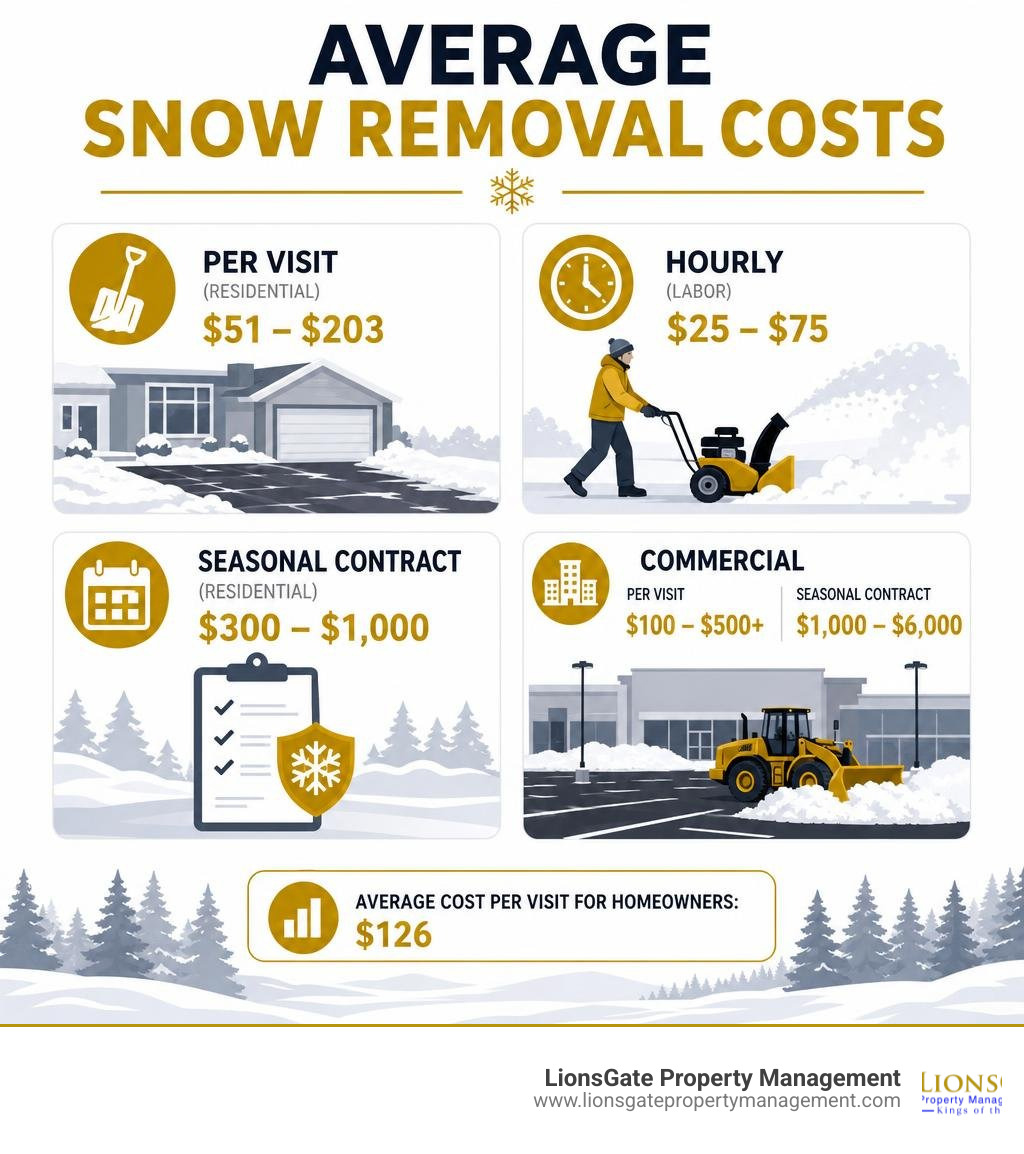
Snow removal cost averages $126 per visit for most homeowners, but what you actually pay depends on your property size, location, and the type of service you choose.
Here's a fast breakdown:
| Service | Typical Cost |
|---|---|
| Per visit (residential) | $51 – $203 |
| Per hour (labor) | $25 – $75 |
| Per inch (first 6 inches) | $10 – $25/inch |
| Seasonal contract (residential) | $300 – $1,000 |
| Commercial per visit | $100 – $500+ |
| Commercial seasonal contract | $1,000 – $6,000 |
For most homeowners, the real choice is between paying $51–$203 per visit or locking in a seasonal contract for $300–$1,000 — and in a snowy region like Rhode Island, the seasonal contract almost always wins on value.
Whether you manage a single rental or a small portfolio of multifamily properties, knowing these numbers upfront helps you budget smarter and avoid getting caught off guard mid-winter.
I'm Isaac Spragg, founder of LionsGate Property Management, and I've dealt with the real snow removal cost pressures that come with managing rental properties across Providence, Cranston, Warwick, and Pawtucket. From negotiating seasonal contracts to handling liability risks on icy walkways, I'll walk you through everything you need to know to make the right call for your property.
What is the Average Snow Removal Cost?
When winter storms roll through Rhode Island, leaving a thick blanket of heavy, wet snow across our driveways and walkways, clearing it becomes an urgent priority. For most residential properties, the national average snow removal cost lands at $126 per visit, with a typical pricing spectrum spanning from $51 to $203.
However, "average" is a loose term when you consider the sheer variety of properties we manage. A compact, single-car driveway in North Providence requires significantly less effort than a sprawling multi-family parking lot in Cranston. To help you budget effectively for the 2026 winter season, it is crucial to understand the different pricing structures contractors use.
| Pricing Model | Average Rate (Residential) | Best Suited For |
|---|---|---|
| Per Visit / Per Push | $40 – $100 | Regions with light, unpredictable snowfall |
| Per Hour | $25 – $75 (labor only) | Complex layouts, heavy manual shoveling, or custom requests |
| Per Inch | $10 – $25 (first 6 inches) | Areas with highly variable storm depths |
| Seasonal Contract | $300 – $1,000 | High-snowfall regions where predictable budgeting is a priority |
Selecting the right model depends entirely on your risk tolerance and how much snow actually falls. If you want to dive deeper into how local professionals structure these estimates, you can explore the 2026 Snow Plowing & Removal Cost | Get Estimates guide.
Pricing Models: Per-Visit, Per-Hour, and Seasonal Contracts
Choosing how you pay for snow removal is a balancing act between risk and reward. Let's look at the mechanics of the three primary pricing models:
- Per-Visit (or Per-Push) Pricing: Under this model, you pay a flat fee (typically $50 to $200) every time the plow truck clears your driveway. If it snows twice in one week, you pay twice. If it doesn't snow all January, you pay nothing. This is highly cost-effective during mild winters but can quickly drain your budget during a historically active season.
- Hourly Rates: Typically ranging from $25 to $75 per hour for manual labor (shoveling and snowblowing) and up to $180 per hour for heavy plow truck operations. Hourly pricing is common for properties with complex layouts, steep inclines, or narrow walkways where a plow cannot easily navigate. The downside? You are at the mercy of how fast the crew works.
- Seasonal Contracts: Ranging from $300 to $1,000 for residential properties, a seasonal contract is an all-inclusive agreement running from November through March. You pay a fixed fee upfront or in monthly installments, and the contractor clears your property every time the snowfall exceeds a predetermined "trigger depth" (usually 2 inches).
For property owners who need to keep operating expenses highly predictable, we always emphasize the value of seasonal agreements. To understand why flat-rate winter budgeting is so critical for landlords, read our detailed analysis on The Cold Hard Truth About Snow Removal Service Prices.
Residential Snow Removal Cost by Service Type
Not all snow clearing is created equal. The physical method used to clear your property directly impacts the final invoice:
- Snow Plowing: The fastest and most common method for driveways. Plowing costs average $50 to $175 per visit. A plow truck can clear a standard two-car driveway in minutes, but it is limited to wide, open surfaces.
- Snow Blowing: Perfect for mid-sized walkways, short driveways, and properties where there is limited space to pile plowed snow. Expect to pay $50 to $150 per visit. Snowblowers are highly efficient and minimize the risk of scraping or chipping your pavement.
- Hand Shoveling: The most labor-intensive method, costing $40 to $100 per hour. Shoveling is reserved for tight spaces, front steps, porches, and narrow pathways leading to oil fill valves or trash bins.
If you are trying to determine what a fair rate looks like specifically for your driveway, check out The Ultimate Guide to Average Driveway Snow Plowing Rates for a complete breakdown of pricing by driveway length and shape.
Commercial Snow Removal Cost vs. Residential Rates
If you own a commercial building, a large apartment complex, or manage an HOA subdivision in Rhode Island, residential pricing does not apply. Commercial snow removal is a completely different beast, driven by strict liability standards, massive surface areas, and heavy equipment requirements.
While a residential visit tops out around $200, commercial snow plowing averages $100 to $500+ per visit, with seasonal contracts running anywhere from $1,000 to $10,000+ depending on the acreage.
Commercial contracts must account for high-traffic walkways, emergency lane clearances, and dedicated salt applications to prevent slip-and-fall lawsuits—which carry an average settlement cost of $30,000. For condo boards and apartment managers, coordinating these services requires a professional touch. Learn more about managing these specialized needs in our guide on Snow Removal Services for Condo and Apartment Boards.
Key Factors and Materials Affecting Snow Removal Pricing

Calculating the exact snow removal cost for a property requires looking beyond simple square footage. Contractors evaluate several physical and environmental variables before drafting a quote.
- Driveway Length and Layout: A straight, flat driveway is simple to plow. A winding, steep driveway with a retaining wall or tight turns requires precision, slower speeds, and often manual touch-ups, driving up the price.
- Surface Material (Gravel vs. Paved): Plowing a paved asphalt or concrete driveway is straightforward. Gravel driveways require the plow blade to be raised slightly to avoid scooping up stones, which leaves a thin layer of snow that must be cleared via alternative methods. Clearing a gravel driveway can easily add $50 to $100 to the service cost.
- Obstacles: Built-in mailboxes, fire hydrants, landscape lighting, and parked cars slow down operators. If a driver has to repeatedly get out of the truck to move obstacles or check clearances, your labor costs will rise.
- Storm Timing and Emergency Service: If a blizzard hits at 2:00 AM on Christmas Day and you need your driveway cleared immediately, expect an emergency surcharge of $50 to $100 above standard rates.
Property Size, Snowfall Depth, and Regional Location
Property size and snowfall depth are the two most objective metrics used to calculate costs.
For residential driveways, size-based pricing typically breaks down as follows:
- Small Driveway (1 Car): $40 – $75 per visit | $300 – $400 seasonal
- Medium Driveway (2 Cars): $75 – $125 per visit | $400 – $600 seasonal
- Large Driveway (4+ Cars): $125 – $250 per visit | $600 – $1,000 seasonal
Snowfall depth also triggers tiered pricing. Most contractors charge a base rate for the first 6 inches of snow. After that, they apply a depth surcharge—typically $10 to $25 per inch for the first 6 inches, and then $4 to $9 for each additional inch of accumulation. Heavy, wet snow also costs more to clear than light, fluffy powder because of the added strain on equipment and slower clearing speeds.
Your geographic location within Rhode Island also dictates your local pricing. Municipal ordinances in cities like Providence, Cranston, and Pawtucket require property owners to clear public sidewalks adjacent to their property within a strict timeframe (often 4 to 24 hours after a storm ends) or face municipal fines.
To see how local conditions and municipal equipment costs impact public and private clearing budgets, read about Providence's Rented Snow Removal Equipment Costs.
If you are looking for specific regional services and localized estimates, you can check out these dedicated local directories:
- Find local plowing professionals via Snow Plowing Services Cranston
- Request custom estimates through Snow Removal Warwick RI | Snow Plowing | FREE Estimates
- Browse highly-rated local options on THE BEST 10 SNOW REMOVAL IN NORTH PROVIDENCE, RI - Yelp
- Compare verified local pros using Top 10 Best Snow removal pros in East Providence, RI | Angi
- Explore regional service reviews on THE BEST 10 SNOW REMOVAL IN PAWTUCKET, RI - Yelp
De-icing Materials: Rock Salt, Calcium Chloride, and Eco-Friendly Blends
Clearing the snow is only half the battle; preventing the remaining moisture from turning into a sheet of black ice is just as critical. The cost of de-icing depends entirely on the chemical compound used:
- Rock Salt (Sodium Chloride): The most common and affordable option, costing $10 to $25 per application for a standard driveway. While highly effective down to 15°F, rock salt is highly corrosive to concrete, can damage nearby lawn borders, and is harmful to pets' paws.
- Calcium Chloride: A premium alternative that works in extreme cold (down to -25°F). It costs $20 to $40 per application but is significantly gentler on concrete and vegetation than standard rock salt.
- Eco-Friendly Blends: Typically made from CMA (calcium magnesium acetate) or organic byproducts like beet juice. These blends cost $25 to $50 per application. They are non-corrosive, safe for pets, and environmentally friendly, making them highly popular for modern residential rentals.
- Sand Application: Sand does not melt ice, but it provides immediate traction on packed snow. It is often mixed with salt to reduce overall chemical usage and costs roughly $15 to $30 per application.
Additional Fees, Roof Clearing, and DIY vs. Professional Costs
When budgeting for winter maintenance, many property owners overlook the hidden costs and secondary services that often arise during severe storms.
- Emergency Surcharges: Expect to pay an extra $50 to $100 if you call a contractor last-minute during a major blizzard. Contracted customers always receive priority, meaning one-off callers must pay a premium to get on the schedule.
- Tipping: While not mandatory, tipping your snow removal crew is a great way to show appreciation for those working in freezing, hazardous conditions. A tip of 10% to 20% of the service cost, or a flat $10 to $20 for a job well done, is standard.
- Heated Driveway Systems: For property owners looking to eliminate snow removal costs entirely, installing a heated driveway is an option. However, with installation costs ranging from $6,000 to $12,000 (or $12 to $21 per square foot), it represents a major upfront capital investment.
Roof Snow Removal and Ice Dam Mitigation
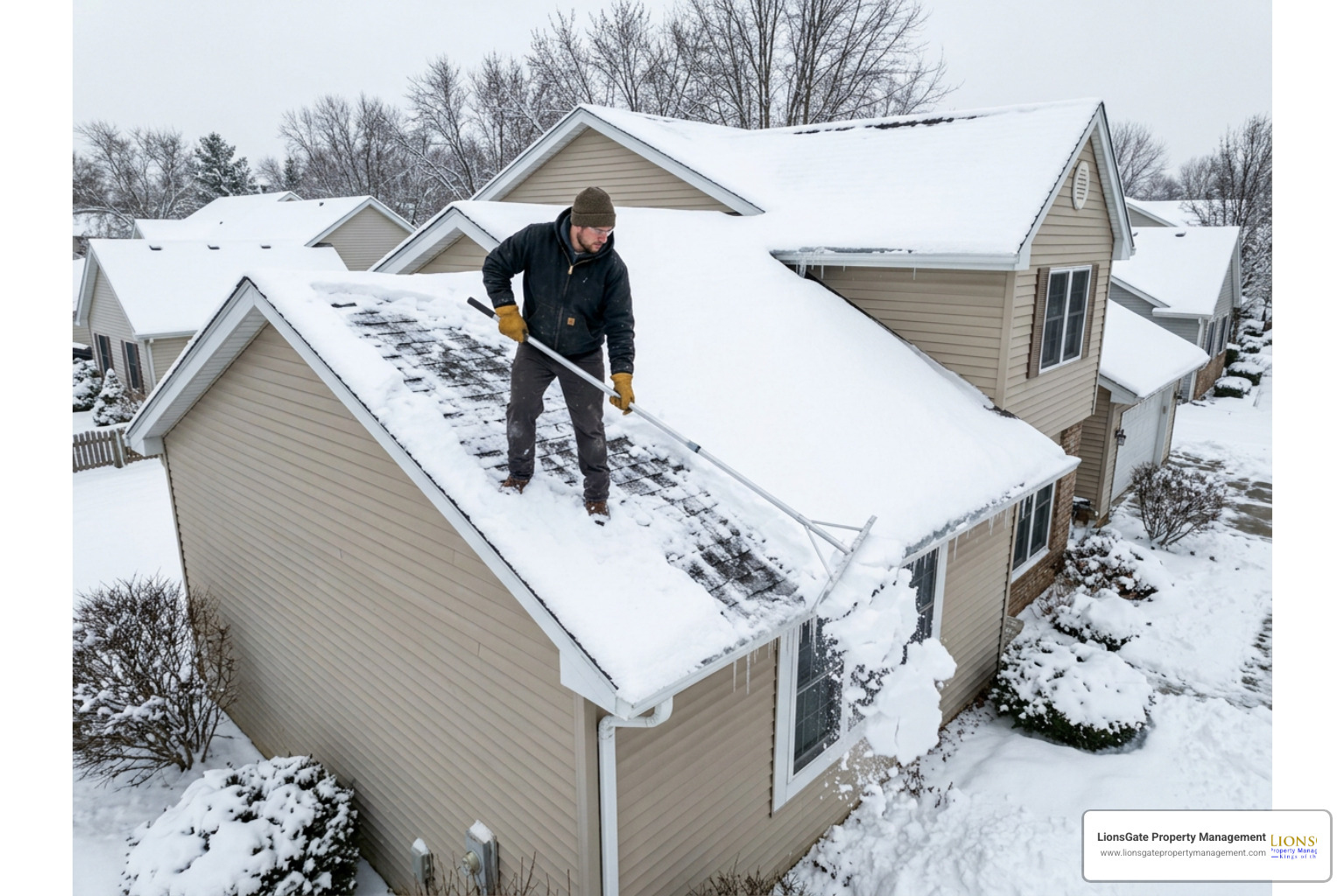
Heavy snow accumulation on your roof is a recipe for disaster. Roofs are engineered to withstand roughly 20 pounds per square foot of snow. When wet snow or ice exceeds this threshold, you risk structural damage or, worse, a roof collapse.
- Roof Snow Removal: Professional roof clearing costs $200 to $500 for standard residential homes, but can reach up to $3,000 for steep, complex, or commercial roofs. Professionals use specialized roof rakes and safety harnesses to clear the snow without damaging shingles.
- Ice Dam Removal: Ice dams form when melting snow refreezes at the cold edge of your roofline, trapping water behind it that eventually seeps into your ceilings and walls. Removing an active ice dam requires specialized high-temperature commercial steamers, costing $400 to $1,000 per hour, with total project costs often ranging from $1,000 to $4,000.
For a detailed look at how service providers calculate these specialized formulas and labor rates, consult the Snow Removal Price Guide 2026: Costs, Rates & Formulas.
DIY Snow Removal vs. Hiring a Professional
It is tempting to look at a snow removal cost estimate and think, "I'll just buy a shovel and do it myself." While DIY clearing is certainly cheaper upfront, it comes with hidden costs, equipment maintenance hassles, and very real physical risks.
Let's look at the financial reality of DIY equipment:
- Ergonomic Snow Shovel: $20 – $115
- Single-Stage Gas or Battery Snowblower: $305 – $800
- Two-Stage Commercial-Grade Snowblower: $800 – $1,800
- Annual Maintenance (Fuel, spark plugs, belts, oil): $50 – $100
If you invest in a quality two-stage snowblower, it will take at least two to three winters of self-clearing to break even compared to hiring a professional service.
More importantly, there is the physical toll. Shoveling heavy snow is incredibly strenuous. Nationally, there are approximately 11,500 snow-shoveling injuries (including severe lower back strains, slips, falls, and exertion-induced heart attacks) and over 5,000 snowblower-related injuries treated in emergency rooms every single year.
For property owners, busy professionals, and seniors, the safety and convenience of a professional service far outweigh the marginal savings of DIY labor. To learn how to navigate local winter storms safely and efficiently, read Don’t Get Snowed In: Your Go-To Guide for Local Snow Clearance.
Frequently Asked Questions About Snow Removal
How much should you tip a snow removal professional?
Tipping is highly appreciated but entirely optional. If you have a per-visit contract, tipping $10 to $20 per driver after a major storm is a generous gesture. For seasonal contracts, many property owners prefer to hand out a holiday card containing $50 to $100 in cash or a gift card at the end of December to thank their dedicated driver for the season.
Does homeowners insurance cover snow removal liability?
Standard homeowners insurance does not cover the cost of routine snow removal. However, it does play a massive role in liability. If a mail carrier, tenant, or visitor slips and falls on an icy pathway that you failed to clear, your homeowners or landlord liability insurance may cover the medical and legal costs—but you risk premium hikes or policy non-renewal.
This is why we always insist that any professional snow removal contractor you hire must carry comprehensive general liability and commercial auto insurance. If they damage your driveway, take out a mailbox, or perform a subpar job that leads to an injury, their insurance should cover the damages, protecting your personal assets.
How can I reduce my overall snow removal expenses?
If you want to keep your winter maintenance budget under control, use these three proven strategies:
- Sign a Seasonal Contract Early: Contractors offer their best rates in September and October. Waiting until the first snowflake falls to secure a contract means you will pay premium, last-minute pricing.
- Bundle Your Services: Many landscaping companies transition to snow removal in the winter. By signing a year-round contract that covers spring cleanups, summer lawn care, and winter snow removal, you can often secure a 10% to 15% discount across all services.
- Clear Obstacles and Share with Neighbors: Ensure your driveway is free of toys, potted plants, and vehicles before the storm hits so the plow driver can work quickly. Additionally, talk to your neighbors; if an entire cul-de-sac or adjacent properties sign up with the same contractor, the company can save on travel time and will often pass those savings along to you.
For families caring for older relatives, securing reliable, cost-effective winter services is a top priority. Learn about specialized options in our guide on How to Find Reliable Snow Removal for Seniors.
Conclusion
Managing the snow removal cost for your property doesn't have to be a source of winter anxiety. By understanding the local pricing models, locking in a seasonal contract early, and choosing the right de-icing materials, you can keep your property safe, accessible, and compliant with local municipal codes all winter long.
At LionsGate Property Management, we take the stress out of winter maintenance for rental property owners across Rhode Island. Providing full-service rental property management for duplexes, triplexes, and small-to-mid-size apartment buildings in Providence, Cranston, Warwick, Pawtucket, and North Providence, we deliver a truly stress-free ownership experience.
Our comprehensive management packages feature a robust suite of guarantees designed to protect your investment:
- Guaranteed Rent: Sleep easy knowing your monthly cash flow is secure.
- Proactive Maintenance: We address minor property issues before they turn into costly emergency repairs.
- Professional Snow Removal: We handle the scheduling, contracts, and execution of winter clearing so your tenants stay safe and you avoid city fines.
- No-Cost Evictions: In the rare event that a tenancy doesn't work out, we handle the legal process at no additional cost to you.
Let us handle the cold, hard work of winter property maintenance while you enjoy the rewards of hassle-free ownership. For multi-family owners and residential boards looking to streamline their winter operations, explore our dedicated services by visiting Snow Removal Services for Condo and Apartment Boards.