
Tenant Placement Services 101: Stop Swiping Left on Bad Renters

Why Tenant Placement Services Can Make or Break Your Rental Income
Tenant placement services are professional solutions that find, screen, and move qualified renters into your rental property — so you stop losing money to vacancies and bad tenants.
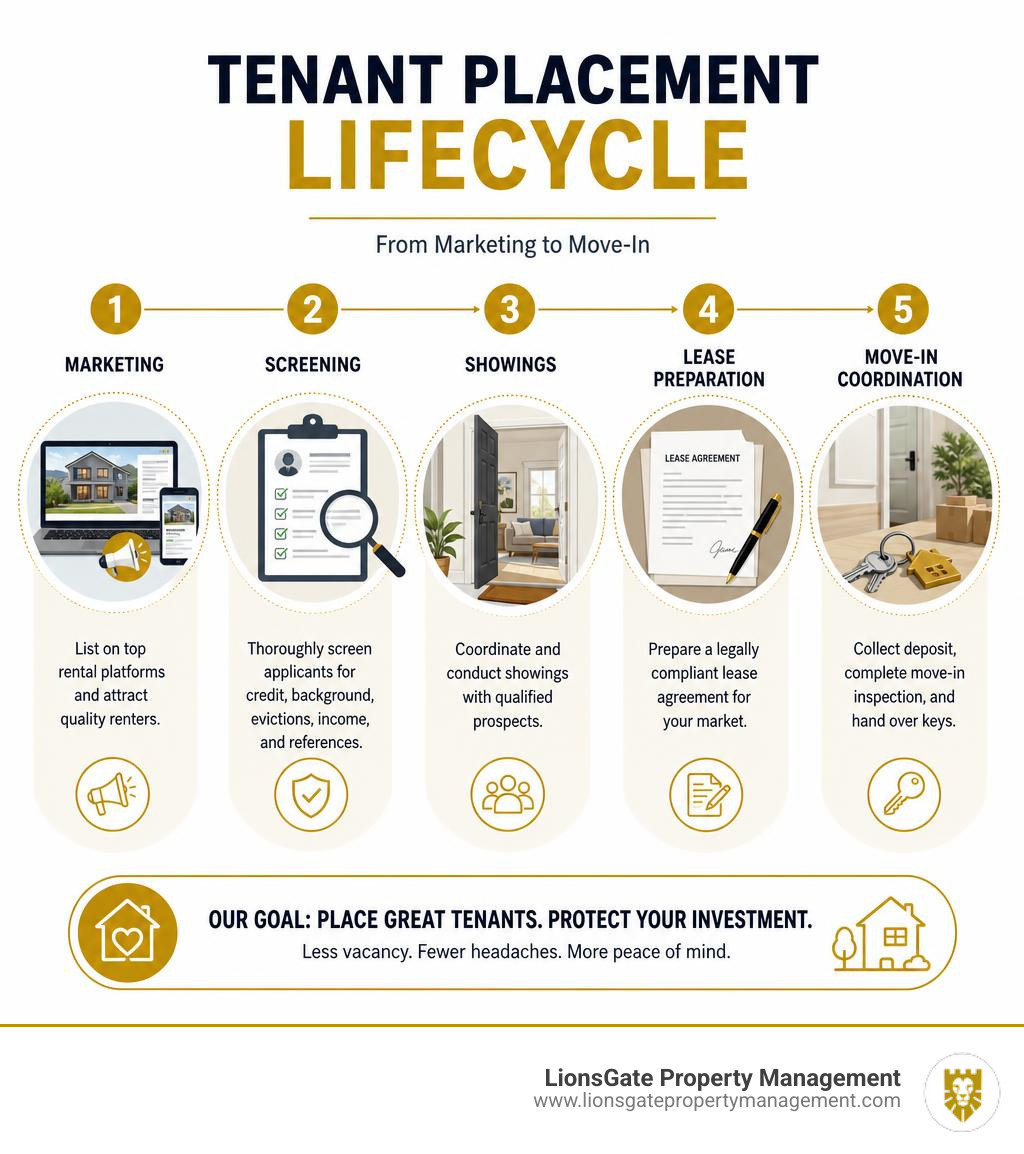
Here's what tenant placement services typically include:
- Property marketing — listing your rental on Zillow, Apartments.com, MLS, and 15+ other platforms
- Tenant screening — credit checks, criminal background, eviction history, income verification, and rental references
- Showings — coordinating and conducting property tours with prospective renters
- Lease preparation — drafting a legally compliant lease agreement for your market
- Move-in coordination — collecting the security deposit, conducting a move-in inspection, and handing over keys
Cost: Typically one month's rent, or a flat fee between $500 and $2,000, paid once at lease signing.
Every day your rental sits empty, you're losing money you'll never get back. Research shows that vacant properties cost landlords roughly 3% of monthly rent per day in lost income — that adds up fast. And filling that vacancy with the wrong tenant? That can cost even more in damages, missed rent, and eviction fees.
For landlords managing duplexes, triplexes, or small apartment buildings in Providence and surrounding Rhode Island communities, the pressure to find reliable tenants quickly — without cutting corners on screening — is very real.
That's exactly what this guide is about.
I'm Isaac Spragg, founder of LionsGate Property Management, and I've built my approach to tenant placement services on hands-on experience managing my own real estate investments alongside hundreds of Rhode Island rental units. In this guide, I'll walk you through everything you need to know — from how the process works to what it costs and how to avoid the most common pitfalls.
What Are Tenant Placement Services?
At its core, a tenant placement service is a specialized real estate service designed to handle the front-end headache of rental ownership: tenant acquisition and vacancy reduction. Instead of dealing with the endless cycle of listing properties, answering late-night inquiries, hosting open houses, and running background checks, you hire professionals to deliver a qualified, lease-signing tenant directly to your door.
However, many landlords confuse tenant placement with full-service property management. The difference is simple but critical: timeline and scope of responsibility.
Tenant placement is a transactional, one-time service. Once the tenant is screened, the lease is signed, the security deposit is collected, and the keys are handed over, the placement company bows out. From that moment on, you (the landlord) resume daily operations. You collect the rent, coordinate maintenance, handle emergency middle-of-the-night calls, and manage the relationship.
Full-service property management, on the other hand, is an ongoing partnership. The manager handles everything from tenant acquisition to daily maintenance, rent collection, and, if necessary, evictions.
To help you decide which path makes sense for your portfolio, explore The Landlord’s Guide to Every Type of Property Management Under the Sun.
Tenant Placement vs. Full-Service Property Management
| Feature / Service | Tenant Placement Services | Full-Service Property Management |
|---|---|---|
| Primary Goal | Fill your vacant unit with a qualified tenant | Manage the asset long-term for maximum ROI |
| Duration | One-time transaction (ends at move-in) | Ongoing monthly partnership |
| Marketing & Showings | Yes | Yes |
| Comprehensive Screening | Yes | Yes |
| Lease Drafting & Signing | Yes | Yes |
| Security Deposit Collection | Yes | Yes |
| Ongoing Rent Collection | No (handled by landlord) | Yes |
| Maintenance & Repairs | No (handled by landlord) | Yes (24/7 coordination) |
| Tenant Relations | No (handled by landlord) | Yes |
| Eviction Management | No (consultation only) | Yes (often covered under plans) |
| Typical Fee Structure | 50% to 100% of first month's rent | 8% to 12% of monthly rent + setup fees |
Deciding between these two models depends entirely on your lifestyle, geographic proximity to your properties, and how much "sweat equity" you want to invest. If you live in Cranston but own a duplex in Pawtucket, and you enjoy managing tenant relationships but hate the stress of marketing, tenant placement services might be your ideal middle ground. If you want a completely passive investment, full-service management is the way to go.
The Step-by-Step Tenant Placement Process
How does a professional service take a vacant, quiet apartment and turn it into a revenue-generating asset in a matter of weeks? It comes down to a highly structured, repeatable process.
Phase 1: Property Evaluation and Strategic Pricing
Before a single picture is taken, a professional service evaluates your property. We look at comparable rentals in your exact neighborhood, whether that is the East Side of Providence, the historic streets of Pawtucket, or the quiet neighborhoods of North Providence. Setting the right price is a delicate science. Price it too high, and your property sits vacant, costing you roughly 3% of your monthly rental income every single day. Price it too low, and you leave thousands of dollars on the table over the course of a multi-year tenancy.
Phase 2: Professional Property Marketing & Syndication
Once the optimal rent price is established, the listing is prepared. Professional tenant placers do not just snap blurry smartphone photos and post them on Craigslist. They utilize high-quality photography, detailed floorplans, and sometimes 3D virtual tours to make the listing pop.
From there, they initiate a marketing blitz. Using professional real estate tools and licensing, they syndicate the listing to the local MLS (Multiple Listing Service) and over 55 major rental platforms, including Zillow, Apartments.com, and Realtor.com. This level of exposure is something DIY landlords simply cannot access on their own, and it is a major reason why professional listings lease up so much faster.

Phase 3: Inquiry Management and Responsive Showings
When a rental listing goes live in a high-demand market like Rhode Island, the inbox floods instantly. Managing these inquiries is a full-time job. Tenant placement services act as a buffer, pre-screening inquiries to ensure applicants meet basic criteria (such as income-to-rent ratios and pet policies) before scheduling a showing.
Showings are coordinated rapidly. Whether using dedicated showing coordinators or secure, biometric ID-verified self-guided lockbox tours, the goal is to get qualified prospects through the door as quickly as possible. Responsive showing coordination is a key driver in reducing vacancy times.
Comprehensive Tenant Screening and Risk Assessment
This is the most critical phase of the entire process. If you skip steps here, you might end up with a tenant who looks great on paper but stops paying rent by month three. A professional screening process goes far deeper than a simple credit check.
[Applicant Submission]
 -> [Identity & Biometric Verification]
 -> [Credit Report & Debt-to-Income Analysis]
 -> [National Criminal & Eviction Database Search]
 -> [Direct Employer & Previous Landlord Verification]
 -> [Final Risk Assessment & Recommendation]
When we perform screening, we analyze several key metrics to build a comprehensive risk profile:
- Credit Report Analysis: We look beyond the three-digit score. We analyze payment history, outstanding collections (especially utility bills or past landlord debts), and overall debt-to-income ratios.
- Criminal Background Check: A thorough check at both national and county levels ensures safety and compliance with local regulations.
- Eviction History Search: Eviction history is one of the strongest predictors of future tenancy issues. We run comprehensive database searches to identify past filings.
- Employment and Income Verification: Standard industry best practices require an applicant's gross monthly income to be at least three times (3x) the monthly rent. For example, if your Pawtucket apartment rents for $2,000, the household must bring in a verifiable $6,000 per month. We verify this directly through recent pay stubs, W-2s, or tax returns for self-employed individuals.
- Rental History Verification: We do not just call the current landlord, who might give a glowing review simply to get rid of a problematic tenant. We prioritize contacting previous landlords to get an honest, unbiased assessment of the applicant's payment history, property care, and neighbor relations.
By compiling these data points into a clear risk assessment, tenant placement services allow you to make an informed, objective, and Fair Housing-compliant decision without emotional bias.
Lease Preparation and Move-In Coordination
Once you approve the ideal applicant, the administrative work begins. A quality tenant placement service handles the heavy lifting of lease execution and onboarding.
Custom, Locally Compliant Lease Agreements
Landlord-tenant laws in Rhode Island are highly specific. Using a generic lease template downloaded from the internet is a recipe for legal trouble. Professional placement services draft custom leases that comply with all local, state, and federal laws. To understand the unique legal framework in our state, review Residential Leasing in Rhode Island: What Landlords Need to Know.
Security Deposit and Move-In Fund Handling
The service coordinates the collection of the first month's rent and security deposit. These funds must be handled securely, often utilizing escrow or trust accounts, to ensure compliance with Rhode Island laws regarding security deposit limits (which cannot exceed one month's rent) and banking requirements.
Detailed Move-In Inspections
Before the keys are handed over, a comprehensive move-in inspection is conducted. The coordinator walks through the property, documenting its exact condition with detailed notes and extensive photographs. This creates an indisputable baseline of the property's state. If disputes arise over the security deposit when the tenant eventually moves out, this document is your shield.
Finally, the service coordinates key transfer, provides the tenant with utility transfer instructions, and sets up the communication channels for their transition to your care.
The Cost of Tenant Placement Services
For most landlords, the decision to hire a service comes down to dollars and cents. How much do tenant placement services cost, and is it worth the investment?
The fee structures generally fall into two categories:
- Percentage of Rent (Most Common): Most professional leasing and placement agencies charge a fee equivalent to one month's rent (100%) or a percentage ranging from 50% to 100% of the first month's rent. This fee is performance-based, meaning you only pay once a qualified tenant is successfully placed and the lease is signed.
- Flat Fee: Some companies offer flat-rate packages, typically ranging from $500 to $2,000 depending on the size and type of the property. For instance, a small condo might have a lower flat fee, while a large single-family home or estate property might sit at the higher end.
The True Cost of Vacancy: A Quick Calculation
To understand the value of this service, you have to compare the placement fee to the cost of vacancy.
Let's look at the math. Every day your property sits vacant, you lose approximately 3% of your monthly rent.
If your rental in Cranston or Warwick commands $2,200 per month:
- Daily Vacancy Cost: ~$66 per day
- 2 Weeks of Vacancy: $924 lost
- 4 Weeks of Vacancy: $1,848 lost
Because professional marketing, MLS syndication, and dedicated showing coordinators typically lease properties 1 to 3 weeks faster than self-managed, DIY marketing efforts, the service practically pays for itself by dramatically shortening your vacancy window.
Understanding the Value of Professional Tenant Placement Services
Beyond the math of vacancy costs, outsourcing this process delivers several intangible but highly valuable benefits:
- Unmatched Marketing Reach: DIY landlords are usually limited to posting on free consumer sites. Professional placement services leverage licensed brokerage status to syndicate your listing to premium platforms and the local MLS, putting your property in front of high-quality renters who don’t look on Craigslist.
- Time Savings: Think about the hours spent answering duplicate inquiries, waiting at the property for prospects who "no-show," running credit checks, and chasing down references. Outsourcing frees up your nights and weekends.
- Local Market Expertise: Knowing exactly what renters in East Providence or North Providence are looking for—and what they are willing to pay—ensures your property is positioned perfectly in the market.
Benefits and Risks of Outsourcing Tenant Placement
While the benefits are substantial, smart real estate investing requires looking at both sides of the coin. Let’s break down the advantages and potential risks of using a tenant placement service.
The Benefits
- Rigorous Fair Housing Compliance: Federal, state, and local Fair Housing laws are incredibly strict. A single mistake in your screening process or listing description can lead to devastating discrimination lawsuits. Professional placement services use standardized, objective criteria to ensure 100% legal compliance.
- Higher Tenant Quality: Because of deep screening protocols, professional placement historically results in tenants who pay rent on time, treat the property with respect, and stay longer, reducing your long-term turnover costs.
- Buffer from Emotion: It is easy for landlords to make emotional decisions based on a "good feeling" about an applicant. A placement service keeps the transaction purely business-focused.

The Risks and How to Avoid Them
- The "Placement and Run" Risk: Because the placement service does not manage the property long-term, some lower-quality operators might be tempted to place any tenant just to collect their one-time fee.
- Miscommunication: If the placement service doesn't fully understand your specific property rules (such as utility splits in a multi-family duplex or specific parking rules), it can lead to friction once the tenant moves in.
- Lack of Control: If you prefer to shake hands and personally interview every applicant, you might find it difficult to hand the screening reins over to an agency.
To minimize these risks, always work with a reputable, licensed local property management company that stands behind its work with guarantees.
Mitigating Risks with Tenant Placement Services Guarantees
The best way to protect yourself from a bad placement is to work with a company that offers a tenant placement guarantee.
Many high-quality firms offer a 6-month to 12-month replacement guarantee. This means if the tenant they placed defaults on rent, breaks the lease, or has to be evicted within the first several months of their tenancy, the placement company will find a qualified replacement tenant for free or at a heavily discounted rate.
When you combine professional placement with an ongoing management plan, these guarantees often extend even further. Establishing a strong start is crucial for a smooth tenancy; for tips on managing the relationship after the placement is complete, read about How to Strengthen Tenant Relations for Lasting Rental Success.
Frequently Asked Questions About Tenant Placement
Navigating the rental market can bring up a lot of questions. Here are the answers to the most common concerns landlords have when considering tenant placement services.
How long does the tenant placement process typically take?
On average, a well-established tenant placement service can find and place a qualified tenant within two to four weeks.
However, the exact timeline depends on several key factors:
- Pricing Accuracy: Properties priced at or slightly below market value lease up almost instantly, while overpriced units sit.
- Property Condition: A clean, modern, "rent-ready" home will always attract applicants faster than one needing repairs.
- Seasonal Demand: The Rhode Island rental market is highly seasonal. Peak renting season runs from late spring through summer (May to August). Trying to place a tenant in November or December generally takes longer due to lower moving activity.
What happens if a placed tenant defaults or breaks the lease early?
If a tenant defaults or breaks their lease early, the outcome depends on your agreement with the placement service:
- With a Guarantee: If the company offers a placement guarantee (typically 90 days to 12 months), they will market the property and place a new tenant at no additional cost to you.
- Without a Guarantee: If you did not have a guarantee in place, the relationship with the service ended at move-in. You will be responsible for handling the lease break, coordinating the move-out, and paying a new fee to find a replacement.
- Eviction Support: If you manage the property yourself and must evict, you will have to handle the legal process. However, if you transition to full-service management, many companies (including us at LionsGate) offer programs like no-cost evictions to absorb the legal fees and hassle on your behalf.
How do placement services ensure compliance with local landlord-tenant laws?
Professional placement services ensure compliance by staying highly educated on changing local regulations and employing licensed real estate professionals.
In Rhode Island, this includes:
- Fair Housing Laws: Ensuring all marketing, screening, and selection processes do not discriminate based on protected classes, including lawful source of income (such as Section 8 housing vouchers).
- Security Deposit Limits: Strictly adhering to the state law that limits security deposits to a maximum of one month's rent.
- Lead Paint Regulations: Ensuring all required state lead disclosure forms and certificates are properly completed and signed prior to lease execution.
- Local Ordinances: Adapting leases to comply with specific municipal codes in cities like Providence, Cranston, and East Providence.
To find reputable agencies that prioritize these standards, you can consult resources like the Tenant Placement Service Directory - Find Tenant Placement Services - Tenant Placement Service .
Conclusion
Finding the right tenant is the single most important factor in determining the profitability and stress level of your rental property investment. While trying to handle marketing, showings, and deep background checks yourself can feel like a second full-time job, professional tenant placement services offer a streamlined, legally compliant, and highly efficient alternative.
If you are a landlord in Rhode Island, you don't have to navigate this alone. Whether you own a classic triple-decker in Providence, a duplex in Cranston, or a multi-family building in Pawtucket, we are here to help.
At LionsGate Property Management, we specialize in managing and leasing duplexes, triplexes, and small-to-mid-size apartment buildings across Providence, Cranston, Warwick, Pawtucket, East Providence, and North Providence. We deliver a completely stress-free ownership experience backed by our unique guarantees: guaranteed rent, proactive maintenance, snow removal, and no-cost evictions.
To learn more about what a professional partner should handle for your portfolio, read our guide on Everything Your Property Manager Should Be Doing for You.
Ready to eliminate vacancy stress and secure high-quality renters for your Rhode Island property? Explore our LionsGate Property Management Services today, and let's get your rental working for you.