
The Big Guide to Finding Commercial Real Estate Management Roles

Why Jobs in Commercial Property Management Are Worth a Serious Look Right Now
Jobs in commercial property management are in high demand across the U.S. right now — and the numbers back that up. Here's a quick snapshot of what's available and what to expect:
Quick Answer: What You Need to Know
| What | Details |
|---|---|
| Where the jobs are | New York (261 open roles), New Jersey (298), Greater Philadelphia (133) |
| Most common titles | Property Manager, Assistant Manager, Portfolio Manager, Facilities Manager |
| Salary range | $50,000 (entry) to $140,000+ (senior/regional) |
| Key skills needed | Yardi, lease admin, CAM reconciliations, budgeting, vendor management |
| Certifications that help | CPM, RPA, state real estate license |
| Work setup | Mostly on-site or hybrid; fully remote is rare |
| Experience required | 2–3 years (entry/mid) up to 7+ years (senior roles) |
Commercial real estate is a complex world — and the people who keep those buildings running are in serious demand. From managing Class A office towers to overseeing retail strips and industrial parks, the field offers a wide range of roles, strong salaries, and clear paths to advancement.
Whether you're just starting out or looking to move into a senior position, understanding how this job market works will help you move faster and smarter.
I'm Isaac Spragg, founder of LionsGate Property Management, and my hands-on experience managing real estate investments gives me a grounded view of what jobs in commercial property management actually involve day to day. That background shapes everything I share in this guide.
Where the Most Jobs in Commercial Property Management Are Right Now
If you want a quick read on demand, the Northeast numbers are loud enough to hear over a rooftop HVAC unit.
The current market snapshot shows:
- 261 commercial property manager jobs in New York
- 298 property manager jobs in New Jersey
- 133 commercial property management jobs in Greater Philadelphia
Those are not tiny niche numbers. They point to a broad hiring market across large urban and suburban portfolios, especially where office, retail, industrial, and mixed-use assets are concentrated.

Jobs in commercial property management by major Northeast market
Here is the headline view from the research:
| Market | Open roles | Hiring pace highlights |
|---|---|---|
| New York | 261 | 205 posted in the past month, 74 in the past week, 13 in the past 24 hours |
| New Jersey | 298 | Strong volume across multiple property management titles |
| Greater Philadelphia | 133 | 111 posted in the past month, 38 in the past week, 4 in the past 24 hours |
A few details matter here:
- In New York, 161 of the 261 roles were concentrated in New York City itself.
- In that same New York group, 245 were full-time and 149 were mid-senior level.
- Also in New York, 36 roles among those 261 offered pay above $100,000.
That tells us two important things. First, employers are not just hiring junior help. Second, salary growth is real when a candidate brings the right experience, software fluency, and financial skill set.
What the numbers say about demand in 2026
In 2026, demand looks strong for a few reasons:
- Large portfolios still need daily operational oversight.
- Employers are replacing experienced managers who move up, move out, or burn out.
- Properties need tighter financial control, especially around operating costs, renewals, and capital planning.
- Hybrid work changed office use patterns, but it did not make buildings manage themselves. If only.
In plain English: owners still need professionals who can keep tenants happy, vendors accountable, budgets on track, and surprises as small as possible.
For Rhode Island job seekers, these large-market trends still matter. Even if you want to build your career closer to Providence, Cranston, Warwick, Pawtucket, or North Providence, the same employer expectations show up again and again: strong communication, financial discipline, lease knowledge, and comfort with property management software.
The Most Common Jobs in Commercial Property Management and What They Pay
The title "property manager" covers a lot of ground. One company may expect a manager to focus on tenant service and vendors. Another may expect deep financial oversight, CAM reconciliations, and capex planning. Same title, very different Tuesday.
Entry-level to senior jobs in commercial property management
These are the most common roles we see in the market:
- Property Administrator
- Assistant Property Manager
- On-Site Property Manager
- Commercial Property Manager
- Portfolio Manager
- Regional Property Manager
- Director of Property Management
- Facilities Manager
- Asset Manager
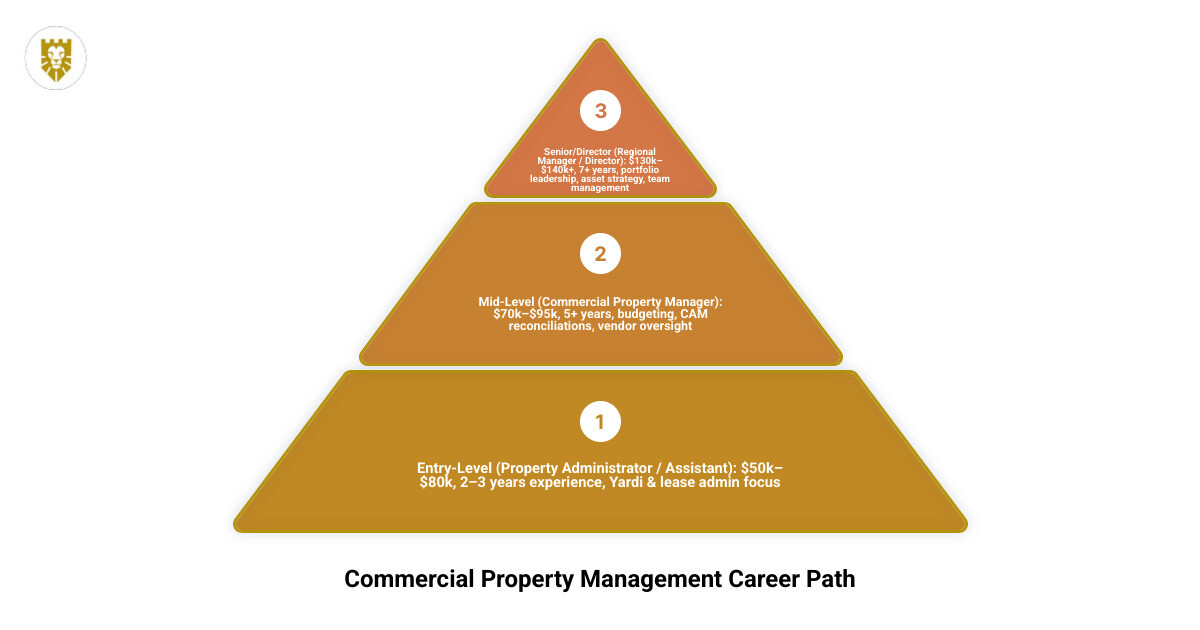
A typical progression looks like this:
- Property Administrator
- Assistant Property Manager
- Property Manager
- Senior or Portfolio Manager
- Regional Manager or Director
At the entry level, support roles often focus on:
- lease files
- tenant communication
- work orders
- invoice tracking
- reporting support
- scheduling vendors
By the middle of the ladder, managers usually own:
- budgets
- renewals
- inspections
- tenant issues
- vendor contracts
- collections follow-up
- CAM reconciliations
Senior roles add:
- multi-property oversight
- staff supervision
- capital planning
- forecasting
- strategic reporting
- client or ownership communication
Salary ranges, bonuses, and what changes pay
Here is a practical pay snapshot based on the research:
| Job title | Typical pay range |
|---|---|
| Assistant Property Manager | $50,000-$80,000 |
| On-Site Property Manager | $70,000-$95,000 |
| Commercial Property Manager | $74,970-$128,520 |
| Commercial Property Manager, hybrid example | $88,114-$97,931 |
| Business development blend role | $75,000-$100,000 plus incentives/commission |
| Senior/Class A Commercial Property Manager | $130,000-$140,000 |
| Regional Property Manager | Up to about $140,000 |
A few factors can move pay up or down:
- Asset class: Class A and more complex properties usually pay more
- Portfolio size: more buildings, more responsibility, more compensation
- Sector: healthcare and industrial can require specialized knowledge
- Travel: some roles require 50% travel
- Work scope: if the job includes business development, pay may include commissions
- Certifications: CPM or RPA can help in senior-level hiring
- Local licensing: a real estate license may be required
- Software and finance skills: Yardi, budgeting, forecasting, and CAM experience increase value fast
The New York data also showed 36 roles paying above $100,000 out of 261 listings. So yes, six figures are very possible in this field, especially once you move beyond basic site operations.
Skills, Certifications, and Qualifications Employers Want Most
The days of "good with people" being enough are over. Helpful? Absolutely. Enough? Not even close.
Commercial employers want operators who can handle tenant relationships and numbers, contracts, systems, and compliance.

The technical skills that appear most in jobs in commercial property management
The most requested skills in current postings include:
- Yardi proficiency
- lease administration
- CAM reconciliations
- budgeting
- forecasting
- variance analysis
- vendor management
- tenant relations
- accounts receivable
- rent rolls
- lease abstracts
- inspections
- emergency response
- Excel and Microsoft Office
Yardi comes up constantly. In the research, it was the most frequently mentioned software requirement across multiple job levels. Other software tools also appear, but Yardi is the name that shows up the most often.
Employers also want people who understand the financial side of the asset, including:
- operating expenses
- service costs
- collections
- annual budgets
- monthly reporting
- capex planning
That is one of the biggest differences between commercial and simpler property management roles. Commercial managers are often expected to think like operators and mini asset managers, not just coordinators.
Certifications, licenses, and experience requirements
The most common qualification patterns look like this:
- 2-3 years of experience for early-career to mid-level roles
- 5+ years for experienced commercial manager roles
- 7+ years for senior or mixed business-development roles
- Bachelor's degree preferred or required in some roles
- State real estate license required in some markets
- CPM preferred for senior positions
- RPA preferred for higher-end commercial roles
One research example made a very clear point: residential experience did not count as a substitute for the required commercial background. That is worth noticing. Employers often draw a hard line between "has managed apartments" and "has handled office, retail, or industrial leases and operating costs."
Real job postings that show what employers ask for
A few live examples help show how varied these roles can be:
- Commercial property manager example role shows a more finance-heavy hybrid position with budgeting, forecasting, lease support, and a salary range of $74,970-$128,520 plus incentive potential.
- Hybrid commercial property manager opening highlights requirements such as a real estate license, at least five years of commercial experience, CAM knowledge, and a work knowledge test.
Those examples reinforce a simple truth: "commercial property manager" is not one job. It is a family of roles that can lean more toward finance, operations, tenant service, or portfolio strategy.
If you want a better feel for what strong management actually looks like from the ownership side, our guide to commercial property management services in Providence is a useful reality check.
Remote, Hybrid, and On-Site Work: What to Expect
Everyone wants to know whether these jobs can be remote. The honest answer: some parts can, but most full roles cannot.
Why most commercial property management jobs are still on-site or hybrid
Commercial properties are physical assets. That means many key duties are physical too:
- building walks
- vendor oversight
- inspections
- tenant meetings
- move-ins and move-outs
- emergency response
- common-area checks
- compliance reviews
- fire drills
- capital project oversight
That is why fully remote roles are rare. Many employers offer hybrid flexibility, but they still expect regular site presence. In the research, some roles were hybrid after an initial training period, while others required at least 50% travel.
Which tasks can be done remotely and which cannot
Tasks often handled remotely:
- reporting
- budgeting
- CAM analysis
- lease review
- owner updates
- invoice review
- email communication
- scheduling
Tasks that usually require physical presence:
- site inspections
- vendor meetings
- tenant walk-throughs
- move-in and move-out coordination
- emergency response
- safety checks
- tour readiness
- maintenance verification
So if you are targeting jobs in commercial property management, expect on-site or hybrid to be the normal setup. Remote-only is the exception, not the rule.
Career Paths and Specializations in Commercial Real Estate Management
This field has more branches than many people realize. You do not have to stay in one lane forever.
How to move from assistant roles to portfolio leadership
A common advancement path looks like this:
- Property Administrator
- Assistant Property Manager
- Commercial Property Manager
- Senior Property Manager
- Portfolio or Regional Manager
- Director of Property Management
- Asset Management or Business Development leadership
To move up, candidates usually need to build proof in four areas:
- financial ownership
- lease fluency
- operational problem-solving
- leadership
The people who advance fastest can show measurable results, such as:
- improved tenant retention
- reduced delinquency
- tighter budget control
- successful vendor negotiations
- completed capex projects
- smoother CAM reconciliation cycles
How office, retail, industrial, and healthcare jobs differ
Not all commercial properties create the same job.
- Office: often heavier on tenant communication, renewals, common-area experience, and service expectations.
- Retail: may include percentage rent, storefront appearance, promotion support, and close attention to co-tenancy or operating hours.
- Industrial: often more focused on logistics, loading areas, maintenance coordination, and travel across wider property footprints.
- Healthcare: usually has stricter compliance expectations and more specialized tenant requirements.
Some roles also blend property management with business development. One posting in the research split the role 70% operations and 30% new business generation. That is a reminder that commercial careers can expand into client acquisition, portfolio growth, and strategic leadership.
For a broader view of how different management models compare, see our article on every type of property management under the sun.
The biggest challenges and rewards of the field today
Let us be honest: this work is not all polished lobbies and impressive keycards.
Common challenges:
- after-hours calls
- vendor failures
- tenant complaints
- lease compliance issues
- collections pressure
- budgeting stress
- balancing owner expectations with tenant needs
- emergency coordination
Common rewards:
- visible career growth
- strong salary upside
- real influence on asset performance
- varied workdays
- leadership opportunities
- satisfaction from making complex properties run well
It is a field for people who like solving problems, juggling details, and keeping calm when everyone else is forwarding the same urgent email.
How to Find Better-Fit Opportunities and Stand Out as a Candidate
A better job search is not just about finding more listings. It is about filtering out bad fits before they waste your time.
Where to look and how to evaluate a role quickly
Use a mix of:
- job boards
- company career pages
- local network referrals
- recruiter outreach
- industry associations
When reviewing a posting, check these first:
- salary transparency
- asset type
- portfolio size
- travel requirement
- software stack
- on-call expectations
- team size
- reporting structure
- on-site vs hybrid expectations
Research also showed large career sites can contain huge property-related inventories. One major careers page alone listed 1,555 property management-related jobs. Volume is helpful, but fit matters more.
If you want to understand what owners look for in a management partner, our article on why your business needs professional commercial rental management gives helpful context.
How to tailor your resume for jobs in commercial property management
Your resume should mirror the language employers use. If the posting asks for CAM, lease administration, Yardi, and budgeting, those terms should appear clearly in your experience section when they are true.
Focus on specifics like:
- managed X-property portfolio
- prepared annual operating budgets
- completed CAM reconciliations
- reduced delinquency by X%
- coordinated vendor contracts and bid reviews
- tracked lease expirations and renewals
- handled tenant improvement or capex projects
- used Yardi for reporting, lease tracking, or billing
Good resumes in this field sound operational, not vague. "Helped with building tasks" is weak. "Managed vendor scheduling, tenant work orders, and monthly financial reporting for a mixed-use portfolio" is much stronger.
Questions to ask before you accept an offer
Before saying yes, ask:
- How large is the portfolio?
- What property types are included?
- How often is site travel required?
- Is there an on-call rotation?
- Which software platforms do you use?
- Who handles accounting support?
- What does success in the first 90 days look like?
- Is there a bonus plan?
- What training support is available?
- What is the growth path from this role?
These questions help you avoid surprises, especially the kind that show up at 9:47 p.m. on a Friday.
Conclusion: Build a Smarter Search Strategy for Commercial Management Roles
The best search strategy for jobs in commercial property management is simple: know the market, know the role, know your strengths, and target positions that match all three.
In 2026, the field remains active, especially across major Northeast markets. Salaries range from roughly $50,000 at the early-career level to $140,000 or more in senior and regional roles. Employers want candidates who can handle software, finances, leases, vendors, and people without dropping the ball.
From our perspective at LionsGate Property Management, the strongest professionals in this industry combine practical judgment with consistent follow-through. They understand that good property management is not glamorous every day, but it is valuable every day.
If you want to learn more about how strong management works in practice, explore our residential and commercial property management services and our breakdown of everything your property manager should be doing.
Frequently Asked Questions about Jobs in Commercial Property Management
Are commercial property management jobs growing in 2026?
Yes. The 2026 research snapshot shows active hiring across major Northeast markets, including 261 open roles in New York, 298 in New Jersey, and 133 in Greater Philadelphia. Recent posting activity also suggests steady hiring velocity, not just stale listings.
Do you need a license or certification to get hired?
Sometimes, but not always. Some employers require a state real estate license, especially for more senior or market-facing roles. CPM and RPA designations are often preferred rather than mandatory. Experience can sometimes outweigh certifications, but advanced credentials usually help with promotion and pay.
Can jobs in commercial property management be remote?
Usually not fully remote. Most roles are on-site or hybrid because the job includes inspections, tenant meetings, vendor coordination, and emergency coverage. Remote work is more common for reporting, budgeting, lease review, and administrative tasks than for the full role itself.